Prime Minister highlights role of economic diplomacy in new era
VGP – Economic diplomacy helps attract foreign resources and open up new development space for Viet Nam's rapid and sustainable development in the new era of the nation's rise, wrote Prime Minister Pham Minh Chinh in his latest article.
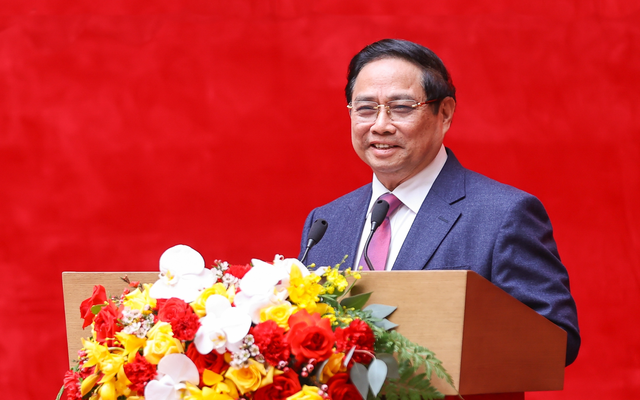
Prime Minister Pham Minh Chinh
Below is the translation of the article for reference:
Prime Minister Pham Minh Chinh wrote that 2025 marks a significant milestone as Viet Nam celebrates the 80th anniversary of the National Day and the 50th anniversary of the liberation of the South and national reunification. Under the leadership of the Communist Party of Viet Nam and beloved President Ho Chi Minh, our nation has made historic miracles. From a country almost unknown on the world map, today Viet Nam has emerged to become a country with increasingly high fortune, potential, international position and prestige. On the threshold of the new era, the whole Vietnamese nation, with its unwavering courage, wisdom, compassion and desire to excel, is doubling efforts to hoist the sails high and steer the Vietnamese ship steadily toward the high sea.
Throughout the history and each development period, Vietnamese diplomacy has made great and signficant cọntributions. From the early days of national independence and reunifcation to the journey of breaking blockade and embargo and advancing comprehensive and extensive international integration, diplomacy left a strong mark, making important contributions to turning risks into opportunities, easing difficulties, reversing adversities and transforming status in order to create an optimal external environment conducive to national development.
In the mid 1970s, after the country was reunifed, our Party, with strategic vision and sharp mindset, precisely evaluated the global situation and domestic conditions, identifying economic diplomacy as a necessity and a new focus to serve post-war rescontruction. Since then, economic diplomacy has left a strong mark in various development and integration milestones, notablly, in studying development models and trends of the world to advise the Party and the State on designing guidelines and policies for economic development and renovation in 1980s; on breaking blockade and embargo and normalizing relations with major international financial institutions, gradually integrating into the global community, attracting foreign investment and assistance in 1990s; on opening up the process of international economic integration, with many especially important milestones that have helped transformed our country since 1995. These are strategic milestones that generate great development opportunities and affirm Viet Nam's major contributions to the regional and global economy.
The mindset and awareness of the Party and the State on economic diplomacy have been ceaselessly renewed and refined to catch up with rapid evolution of the times, meeting new development requirements of our country. Economic diplomacy has always been identified as a key and regular task of diplomatic activities and a fundamental and central pillar of the Vietnamese diplomacy, and an important driving force for fast and sustainable development.
Since the begining of this tenure (2021-2025), the global landscape has experienced more uncertain and unpredictable changes than the previous tenure, with challenges and opportunities intertwined. Nevertheless, our country has obtained proud and historic development achievements across all fields. The national economy proved its resilience against external shocks, with GDP growth rate accelerating to 8.02 percent in 2025, making Viet Nam one of the fastest-growing economies in the region and the world. Especially, macroeconomic stability was maintained, inflation was tamed, and major balances were ensured. The size of the economy reached US$514 billion and GDP per capita was estimated at US$5,026 in 2025, placing Viet Nam among high middle-income countries. All traditional growth drivers (investment, consumption, and export) were effectively promoted. Viet Nam emerged to be among 15 developing countries leading foreign investment inflows and among the top 20 trading nations in the world. New growth drivers made significant progress, in which digital economy and ICT industry growth outpaced GDP growth, Viet Nam led countries with the same income level in terms of global innovation rankings; made initial progress in several key areas such as artificial intelligence, high-speed railway, semiconductor, atomic energy and high-quality human resource training.
Especially, foreign affairs and international integration have become a bright spot amid adverse global situation, in which economic diplomacy has reaped impressive outcomes. Tech diplomacy has been promoted, contributing to creating breakthrough development in science, technology, innovation and digital transformation, and the building of an independent and self-reliant economy in association with extensive international integration. Viet Nam's prestige and position have been increasingly heightened in the global economy, politics and human civilization. Today, Viet Nam has signed and joined 17 free trade agreements; established diplomatic relations with 194 countries, including all members of the United Nations; elevated ties to Comprehensive Partnership, Strategic Partnership, and Comprehensive Strategic Partnership frameworks with 42 major countries, including 17 members of the G20 and five permanent members of the United Nations Security Council. Viet Nam undertook roles at various important multilateral organizations and forums, including being elected to the United Nations Human Rights Council for the 2026-2028 term, hosting the ASEAN Future Forum, the 4th P4G Summit, and the signing ceremony of the UN Convention against Cybercrime, etc.
To achieve the above accomplishments, the diplomatic sector in general and economic diplomacy in particular have made significant, practical and effective contributions. First, diplomacy has contributed to firmly maintaining a stable and favorable environment conducive to expanding national development space, deepening economic cooperation and intertwinement of interests between Viet Nam and partners, especially the neighboring countries, major powers and traditional partners. Second, it has lured external resources for national development, expanding and diversifying markets, drawing foreign investment, knowledge and technology transfer, and upholding the strength of overseas Vietnamese people. Notably, the drastic and rapid implementation of vaccine diplomacy made a direct and important contribution to the Covid-19 pandemic prevention, control and containment, creating favorable conditions for socio-economic recovery and development. Third, it played a pioneering role in fostering international ecnomic integration and linkages, especially elevating Viet Nam's participation and contributions in multilateral economic cooperation mechanisms and its engagement in formulating new international rules and regulations; at the same time, fruitfully leveraging the network of free trade agreements to transform Viet Nam into a hub of regional connectivity. Also, economic diplomacy has accompanied and supported localities and businesses in conducting external economic activities and international economic integration, delivering important and practical benefits and results.
In the new development period, given the complex and unpredictable evolution of the global situation, with difficulties and challenges outweighing opportunities and favorable conditions, economic diplomacy is required to undergo strong transformations to contribute to successful realization of the country's two centennnial strategic goals. The draft documents of the 14th National Party Congress emphasize the need to promote comprehensive diplomacy in service of national development, with economic diplomacy and tech diplomacy defined as a central focus. From this perspective, innovation in economic diplomacy is no longer an option, but has become an objective requirement, an urgent demand, and one of the top priorities in contribution to the realization of the nation's aspiration for powerful and prosperous development.
Accordingly, economic diplomacy in the coming period will shoulder three major responsibilities: (i) contributing to shaping a strategic space for the country to enter an era of strong, civilized and prosperous development; (ii) promoting its role as an important driving force in attracting resources, removing bottlenecks and addressing major challenges in a bid to create breakthroughs in national growth and development, especially in advancing science, technology, innovation, digital transformation and green conversion; (iii) building an independent and self-reliant economy and advancing proactive and active international integration.
With the motto "Resources stem from thinking and vision, motivation stems from innovation and creativity, strength stems from the people and enterprises", economic diplomacy and tech diplomacy need to thoroughly grasp three major lessons while strongly renewing mindset, updating objectives, scope, targets and implementation methods in line with the "five mores" motto.
"Three important lessons" means: (i) unwaveringly sticking to the path of national independence and socialism and the foreign policy of independence, self-reliance, diversification and multilateralization of external relations, active and proactive international integration, being a friend, a trusted partner and a responsible member of the international community; (ii) staying resolute yet flexible, firmly protecting national interests while being highly resilient in implementation to achieve objectives; (iii) fully and thoroughly grasp the situation to put forward policy responses in a timely, flexible, appropriate and effective manner.
"Six mores" motto means: (i) more strategic, sharper in mindset to promptly identify new trends and proactively seize opportunieies to contribute to enhancing the resilience of the economy; (ii) steering more focus on formulating objectives and solutions closely aligned with the national development goals in each period; (iii) further expanding and deepening overall relations and sectoral cooperation with partners, especially in the fields of science and technology, innovation and digital transformation; (iv) more drastic and creative in implementation, ensuring clear undertakers, clear assignments, clear responsibility, clear authority, clear deadline, and clear results; (v) more active and responsible in participating in and contributing to international economic cooperation mechanisms and forums as well as regional and international issues of strategic importance for Viet Nam, particularly in global economic governance, in accordance with Viet Nam's capacity and conditions.
Above all, diplomatic work, especially economic diplomacy must bring into full play the spirit of loyalty and dedication, self-confidence and creativity, mettle and flexibility, negotiation and pursuation, effectiveness and the Fatherland above all in a bid to continue serving as a pioneering and core force in creating new opportunities, new momentum, new external resources for Viet Nam to achieve fast and sustainable development and promote its prestige and position on the international arena.
In the new development phase, diplomatic work in general and economic diplomacy in particularly need to fully grasp and implement the Resolution adopted at the 14th National Party Congress as well as Resolutions of the Party, the National Assembly and the Government, especially the Resolution No. 59 of the Politburo on international integration in the new context, in a holistic, drastic and effective manner. We need to focus on bolstering cooperation in economy, trade, investment, science and technology, digital transformation, green conversion, energy transition, education and training, healthcare, culture, labor, tourism, environmental protection, climate change adaptation while promoting technology transfer in the vital sectors of the national economy like nuclear energy, high-speed railway, semiconductor (with a goal to put the first domestic semiconductor chip factory into operation by 2027); diversifying markets, products and supply chains; utilizing potential markets; accelerating trade promotion in foreign markets; negotiating and singing free trade agreements with countries in the Middle East, Central Asia, Africa, Latin America, etc. Priority should be given to supporting localities and business community, especially small and medium-sized enterprises in international integration; actively supporting businesses to expand investment in global market and engagement in global value chain; luring investment from global tech giants and overseas Vietnamese experts. Also, the diplomatic sector needs to work closely with other sectors, agencies and localities to put forward breakthrough mechanisms, policies and solutions to further advance external relations, particularly economic diplomacy and tech diplomacy to contribute to achieving the goal of double-digit growth rate from 2026 onward.
In this context, we need to have clear mindset, take drastic actions, make non-stop efforts to create breakthrough development in science, technology, innovation, strongly promote green transition in the digital age. This is the central driving force and the golden key enabling Viet Nam to achieve rapid and sustainable development and to successfully realize the strategic goal of becoming a developed, high-income country by 2045 when Viet Nam marks the 100th anniversary of the National day. To this end, we will double efforts in pursuing comprehensive innovation agenda, speeding up administration reform, removing all bottlenecks regarding institutions, infrastructure and workforce so that science, technology, innovation and digital transformation would truly become new driving forces and resources for the nation's rise in the new era.
The achievements gained over the past 80 years have provided an important foundation and a favorable starting point for the country to embark on a new journey. We are firmly confident that diplomatic work in general and economic diplomacy in particular will continue to uphold fine traditions and build on important achievements; strive to overcome difficulties and challenges to seve localities, businesses and people as the prime targets; successfully fulfill its mission assigned by the Party and the State, thus contributing to solidifying the foundations for the nation's fast and sustainable development and bringing prosperity and happiness to the people./.
