Prime Minister attends burial ceremony for martyrs in Quang Tri
VGP - Prime Minister Le Minh Hung attended a funeral and burial ceremony for the remains of 28 Vietnamese volunteer soldiers and experts who sacrificed their lives in Laos during the war period at the National Martyrs' Cemetery on Route 9 in the central province of Quang Tri.
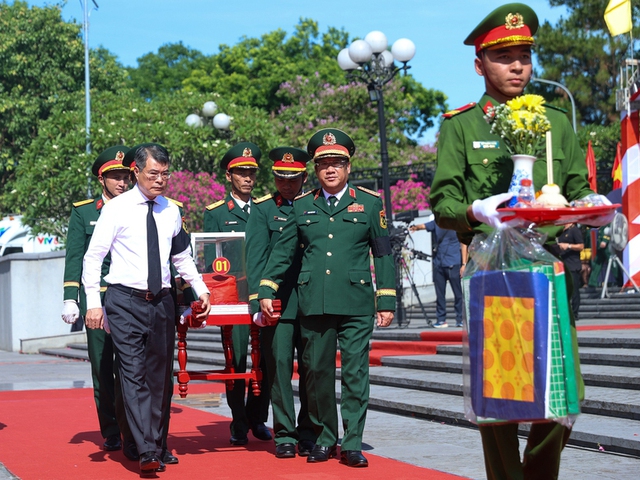
Prime Minister Le Minh Hung (L) attends a funeral and burial ceremony for the remains of 28 volunteer soldiers and Vietnamese experts at the National Martyrs' Cemetery on Route 9, Quang Tri Province, May 23, 2026 - Photo: VGP
The Prime Minister and delegates respectfully commemorated and expressed their profound gratitude to the martyrs who fought bravely and sacrificed their lives for the peace, independence, and reunification of the country.
Following the ceremony, the Government leader presented gifts to the teams responsible for searching and repatriating martyrs' remains, as well as the management board of the National Martyrs' Cemetery on Route 9.
More than 1.2 million martyrs sacrificed for national independence, freedom, and reunification. As of 2025, more than 300,000 martyrs still lacked complete information, and 175,000 martyrs' places of sacrifice had not yet been identified. Nationwide, there are approximately 652,000 war invalids, 198,000 sick soldiers, more than 132,000 Vietnamese Heroic Mothers, and over 300,000 people affected by Agent Orange/dioxin.
Currently, Viet Nam has more than 3,000 martyrs' cemeteries and over 4,000 memorial structures dedicated to martyrs. Among them, the National Martyrs' Cemetery on Route 9 is the eternal resting place of more than 10,800 heroic martyrs who bravely sacrificed their lives on the Route 9 front, the Quang Tri battlefield, and in neighboring Laos.
A nationwide "500-Day-and-Night Campaign" was launched by the National Steering Committee for Search, Collection and Identification of Martyrs' Remains in March this year.
The campaign aims to locate and repatriate approximately 7,000 sets of martyrs' remains; complete the collection of samples from unidentified graves in martyrs' cemeteries nationwide; and conduct DNA testing on around 18,000 samples of martyrs' remains./.