IAEA hands over Report to Viet Nam on its Nuclear Power Infrastructure Development
VGP – The International Atomic Energy Agency (IAEA) on Wednesday handed over the Integrated Nuclear Infrastructure Review (INIR) to Viet Nam.
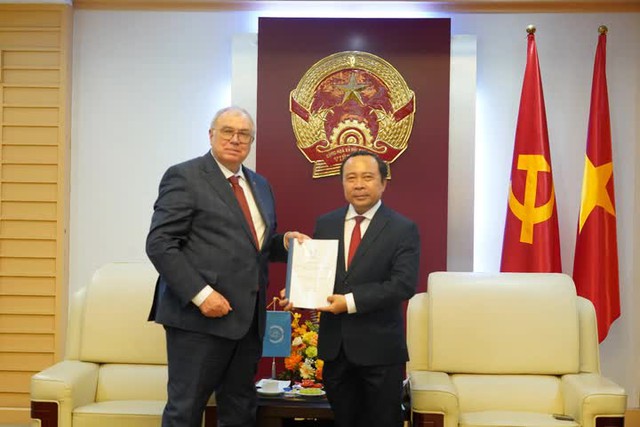
Deputy Director General of the International Atomic Energy Agency Mikhail Chudakov hands over the INIR report to Vietnamese Minister of Science and Technology Vu Hai Quan, Ha Noi, April 22, 2026. Photo: VGP
The INIR report was handed over to Vietnamese Minister of Science and Technology Vu Hai Quan by IAEA Deputy Director General Mikhail Chudakov.
The INIR mission was conducted from 1 to 11 December 2025 at the invitation of the Government of Viet Nam and hosted by the Ministry of Science and Technology.
An IAEA team of experts reviewed the status of 19 nuclear infrastructure issues using the IAEA evaluation methodology for Phase 2 of the Milestones Approach, which assesses a country's readiness to invite bids or negotiate a contract for its first nuclear power plant.
The mission team concluded that Viet Nam has taken major steps to restart and accelerate the Ninh Thuan project and the development of the required infrastructure.
In 2025, Viet Nam enacted a new Atomic Energy Law and adopted special mechanisms to facilitate financial and contractual arrangements for nuclear power plants.
The team identified good practices in government-enabling mechanisms for financing and procurement, as well as in leveraging existing expertise in environmental monitoring for nuclear projects, practices that could benefit other countries developing nuclear power.
The report also contains recommendations and proposals to guide Viet Nam's next steps. These address regulatory independence, nuclear liability, contracting and construction readiness, management systems aligned with IAEA standards, human resource development, stakeholder engagement, and long-term strategies for the fuel cycle and waste management.
Viet Nam first placed nuclear power on its national agenda in the 1980s, then approved, paused, and cancelled. In 2024, the Central Committee of the Communist Party of Viet Nam decided to revive the Ninh Thuan Nuclear Power Project, which had been suspended in 2016, and the National Assembly authorized the Government to allocate the resources needed for implementation.
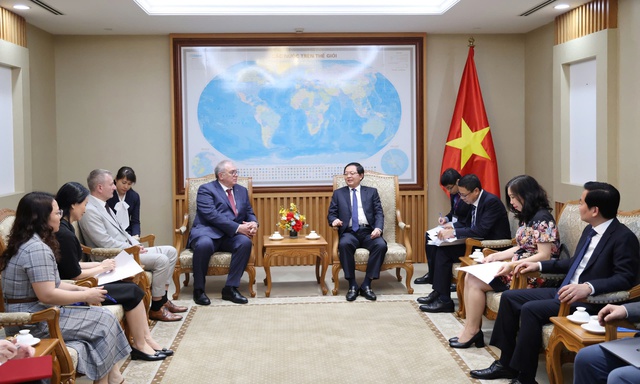
Deputy Prime Minister Ho Quoc Dung hosts a reception for Deputy Director General of the International Atomic Energy Agency Mikhail Chudakov at the Government Office, Ha Noi, April 22, 2026. Photo: VGP
The same day, Deputy Prime Minister Ho Quoc Dung hosted a reception for Mikhail Chudakov.
Chudakov pledged to assist Viet Nam in building nuclear power infrastructure for safe and effective implementation of its nuclear power program.
Chudakov affirmed that IAEA stands ready to assist Viet Nam through training courses, technical tools, and professional consultation, emphasizing that complete preparation of infrastructure and high-quality human resources is the key factor to ensure successful realization of the nuclear power program.
For his side, Deputy Prime Minister Ho affirmed Viet Nam's consistent policy of developing nuclear energy for peaceful purposes in strict compliance with international treaties.
He also affirmed that Viet Nam always considers IAEA as its strategic and reliable partner, and appreciated IAEA's support for Viet Nam through technical cooperation projects.
Ho particularly thanked IAEA for handing over the final report of a peer review mission that assesses the country's development of infrastructure needed for a safe, secure, and sustainable nuclear power program./.