
How supporting industries to thrive?
VGP – To become an industrialized country in the next decade as expected in the Socio-economic Development Strategy 2011-2020, it is urgent for Viet Nam to build up powerful supporting industries.
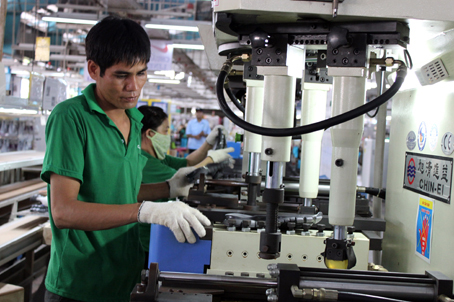 |
| Illustration photo |
At a seminar on the development of supporting industries, held in Ha Noi in August, analysts, managers and entrepreneurs pointed out a number of causes, including non-transparent supporting policies which tend to favor some State-owned businesses only; State-run enterprises’ inactiveness; separation among private enterprises which are main players and aid receivers; and domestic investors’ hesitance and submission to cheap-priced imports.
Efforts of all stakeholders
Mr. Dao Phan Long, General Secretary of the Viet Nam Association of Mechanical Industry (VAMI), said at the seminar that the development of supporting industries must be considered as a national-level strategy.
In 2007, the Government approved a planning scheme for the development of supporting industries to 2010 and visions to 2020. This document places importance on five industries: garment and textile, footwear, electronics-informatics, automobile assemblage and production, and mechanics-manufacturing.
Last year, the PM issued Decision 12/2011/QĐ-TTg to grant supporting industry projects with many incentives in terms of market development, infrastructure, technology, and training laborers.
To realize the decision, Deputy Minister of Industry and Trade Le Duong Quang revealed at a recent meeting, the MIT has shaken hands with Japanese and Korean partners to establish supporting industry parks and clusters in Hai Phong, Ba Ria-Vung Tau and Can Tho.
The MIT also pledged to support investors in supporting industries to access to capital sources, production land, and input materials.
However, enterprises themselves need to proactively seek for capital, partners and markets while improving their technical ability and competitiveness.
Besides, international bidding should not be opened for projects in which domestic contractors can undertake over 50% of the workload. In addition, only input materials and equipment which cannot be produced domestically are permitted to be imported.
Garment-Textile |
- Meeting over 30% of domestic demands for fabric by 2010, about 39% by 2015 and 40% by 2020; - Producing 10-70% of textile mechanical components by 2010 and 40-100% by 2020; - Satisfying 50% of domestic demands for fiber and synthetic thread by 2015 and 80% by 2020; - Ensuring a sufficiency of buttons, thread and zippers; |
Footwear |
- Increasing the use of domestic materials to 40% by 2010 and 70-80% by 2020; - Raising the productivity of leather tanning by 40 million sq. ft by 2010; |
Electronics -Informatics |
- Meeting the demands for simple spare parts, plastic components, circuit boards; - Developing facilities to produce and design highly-integrated semi-conducting systems, embedded software, integrated circuit boards for computers, peripheral devices, electrical goods, and electronic appliances; |
Automobile assemblage and production |
- The percentage of domestically-made components in trucks and buses is 65% and in cars 15% by 2010. The figures are 75%, 85% and 30% for buses, trucks and cars respectively by 2020; - The use of domestic materials to make components between 2010 and 2020: truck cabin 70% and 95%; truck frame 90% and 95%; bus frame 80% and 90%; bus shell 70% and 80%; engine 50% and 60%; gear-box and axle 60% and 75%; wheel hub and cardan 60% and 75%; drive system and front axle 60% and 65%. |
Mechanics-Manufacturing |
Meeting 50% of domestic demands for steel billet by 2010 and 75% by 2020 |
Planning scheme for the development of supporting industries to 2010 and visions to 2020 |
|
By Xuan Hong
