
Health ministry proposes subsidies for families with two daughters
VGP - Families with two daughters may become eligible for tuition exemptions or reductions, student health insurance support, school milk programs and other incentives under a proposal aimed at addressing Viet Nam's persistent imbalance in the sex ratio at birth.
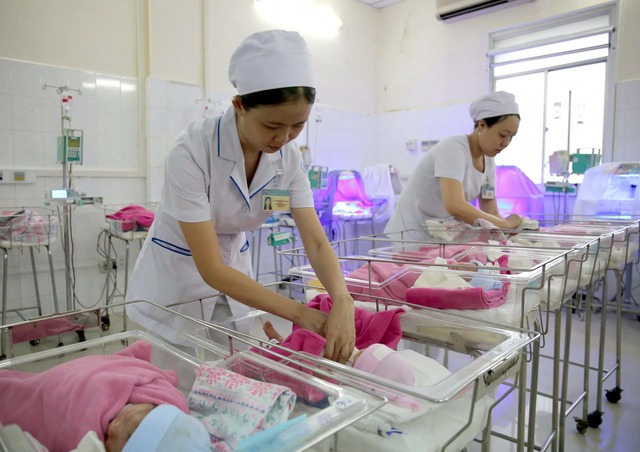
Illustration photo
The proposal is included in a draft Circular developed by the Ministry of Health, which is now open for public feedback before promulgation.
The move comes as Viet Nam's gender ratio at birth remains significantly above the natural level despite years of government efforts to curb gender imbalance.
The gender ratio at birth measures the number of boys born for every 100 girls during a given period, serving as an indicator of whether births are occurring within the natural biological range.
Under the draft, local authorities would have the flexibility to adopt support measures suited to their demographic goals and local conditions for families raising two daughters who are healthy, well-behaved and perform well academically.
Possible incentives include tuition exemptions or reductions, financial support for student health insurance premiums, school milk programs, assistance for women's economic development, and recognition of exemplary families. Priority would be given to girls from poor and near-poor households, ethnic minority and mountainous areas, coastal and island communities, disadvantaged coastal communes, and border communes.
In addition to support for individuals, the Ministry of Health proposes rewarding communes where all villages and residential groups incorporate commitments against gender selection and son preference into their community conventions. Healthcare facilities and service providers that actively participate in public communication and training activities and strictly comply with regulations prohibiting fetal sex selection could also receive financial or in-kind rewards.
According to the ministry, a number of local initiatives have begun to improve public awareness of gender equality. Despite these efforts, progress in reducing the gender imbalance at birth has remained slow.
Population change surveys show that Viet Nam's sex ratio at birth increased from 110.5 boys per 100 girls in 2009 to 111.5 in 2019, before easing slightly to 111.4 in 2024—well above the natural level of around 106 boys per 100 girls.
The sex ratio at birth remains well above the natural level of around 105 boys per 100 girls, indicating that the country's sex imbalance at birth continues to be a significant concern.
This underscores the need for more coordinated and effective measures to achieve the goals set out in the Viet Nam Population Strategy. Under the strategy, the sex ratio at birth is targeted to decline to below 109 boys per 100 girls born alive by 2030.
The imbalance is concentrated mainly in northern provinces, particularly in the Red River Delta, where some localities have recorded ratios as high as 118 boys per 100 girls. By contrast, most southern provinces maintain ratios close to the natural level, ranging from 105 to 108.
The national statistical authority projects that if the trend continues, Viet Nam could face a surplus of approximately 1.5 million men aged 15-49 by 2034, increasing to 1.8 million by 2059. Experts warn that the imbalance could disrupt family structures, leave many men unable to find partners, and lead to delayed marriage or lifelong singlehood.
Dr. Mai Xuan Phuong, former Deputy Director General of the Communications and Education Department under the former General Office for Population (now the Population Authority), said that the traditional preference for sons remains widespread, while Viet Nam's total fertility rate has fallen to 1.91 children per woman, below the replacement level of 2.1.
He noted that when families choose to have only one or two children, demand for prenatal sex selection tends to increase. Combined with the long-standing belief that sons are needed to continue the family line and perform ancestor worship, as well as easier access to prenatal sex determination technologies, these factors have contributed to the prolonged imbalance.
To address the issue sustainably, Dr. Mai said Viet Nam needs a three-pronged approach: a strong legal framework, strict monitoring of healthcare services, and effective public communication campaigns to change societal perceptions about the value of girls.
Under the Law on Population, medical practitioners who disclose the sex of a fetus in violation of regulations may have their practicing licenses revoked./.