
Ha Noi to pilot low-emission zones in nine inner-city wards from this July
VGP - Ha Noi will begin piloting low-emission zones (LEZs) from July 1, 2026, in selected areas within Ring Road 1, covering nine wards namely Hai Ba Trung, Cua Nam, Hoan Kiem, O Cho Dua, Van Mieu-Quoc Tu Giam, Ba Dinh, Giang Vo, Ngoc Ha and Tay Ho.
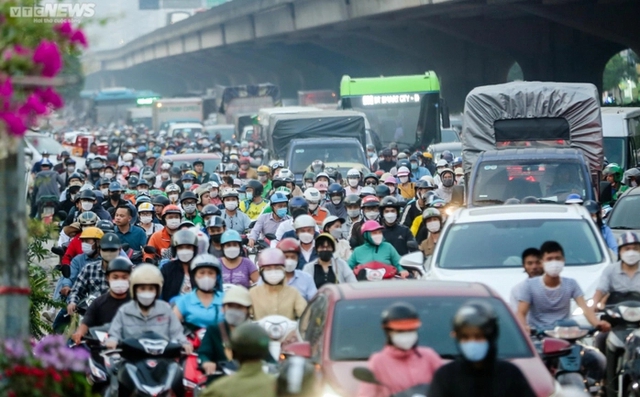
Ha Noi will not impose an outright ban on petrol-powered cars and motorbikes across the entire Ring Road 1 from July 1 - Illustration photo
Deputy Director of the Department of Construction Dao Viet Long reported that the city will not impose an outright ban on petrol-powered cars and motorbikes across the entire Ring Road 1 from the outset. Instead, the rollout will follow a phased approach, applying emission controls based on specific zones, timelines, and target groups.
The Department of Agriculture and Environment has been assigned to lead the development of the LEZ proposal, working closely with the Department of Construction and city police. The plan will specify coverage areas, affected vehicle groups, implementation schedules, as well as technical and management solutions tailored to Ha Noi's conditions.
Proposed measures include restricting vehicles by area, time frame, or emission standards, depending on practical conditions and approved traffic management plans. Authorities stressed that the LEZ initiative is part of a broader strategy to restructure urban transport, rather than a purely administrative restriction, and must ensure residents' interests are protected throughout implementation.
The city will conduct regular reviews and make timely adjustments to allow sufficient time for residents and businesses to adapt before expanding the scheme.
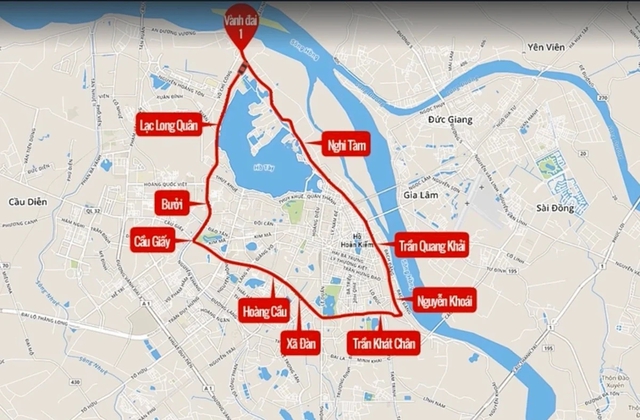
Image of Ha Noi's Ring Road 1
Phased expansion plan
In the initial phase starting July 1, 2026, the LEZ pilot will be implemented in parts of Ring Road 1.
From January 1, 2028, low-emission zones will be implemented across Ring Road 1 and in certain areas within Ring Road 2, including 14 wards including the nine wards along Ring Road 1, as well as Lang, Dong Da, Kim Lien, Bach Mai and Vinh Tuy wards.
From January 1, 2030, the plan is set to expand to areas within Ring Road 3, covering 36 wards and communes, including all wards inside Ring Road 2 and several surrounding localities such as Phu Thuong, Xuan Dinh, Nghia Do, Cau Giay, Yen Hoa, Thanh Xuan, Khuong Dinh, Dinh Cong, Phuong Liet, Tuong Mai, Hoang Mai, Vinh Hung, Long Bien, Phuc Loi, Viet Hung, Bo De, Phu Dong, Dong Anh, Thu Lam, Phuc Thinh, Vinh Thanh and Noi Bai.
Under the plan, new investment in fossil fuel-powered vehicles that contribute to pollution will be restricted, while new registrations—especially for organisational fleets—will be tightly controlled. Replacement will only be allowed when older vehicles are scrapped at the end of their service life. Trucks exceeding 3,500kg in design weight and using fossil fuels will be prohibited from operating within LEZs.
Ride-hailing motorbikes using fossil fuels will be banned from entering LEZs, while other motorcycles and mopeds may face restrictions during specific hours or in designated areas. Cars that fail to meet Euro 4 emission standards will also be gradually restricted and eventually barred from entering these zones.
The local authorities said limiting petrol-powered motorcycles by time or location, rather than enforcing a full ban, reflects feedback from agencies and the public, and is intended to align with infrastructure capacity, social conditions, and travel habits.
Supporting infrastructure and green transition
Ring Road 1 is currently served by two urban railway lines—Line 2A (Cat Linh–Ha Đong metro line) and Line 3.1 (the Nhon–Ha Noi Station metro line)—with a combined capacity of around 462,000 passengers per day, alongside 45 subsidised bus routes capable of carrying over 903,000 passengers daily.
The city is accelerating efforts to green public transport, aiming to maximise the use of environmentally friendly buses in the pilot areas. Plans are also underway to expand public bicycle stations to improve last-mile connectivity and to introduce smaller electric buses suitable for narrow inner-city streets.
To support the transition, the city is developing park-and-ride facilities at key entry points to LEZ areas, allowing commuters to switch from private vehicles to public transport. More than 210 potential parking sites within Ring Road 1 have already been identified.
In addition, authorities are finalising regulations on charging infrastructure and battery-swapping stations, including fire safety standards for older residential buildings. Compact battery-swapping stations are expected to be deployed in public spaces, enabling users to exchange batteries within minutes.
Meanwhile, the Department of Construction is working with relevant agencies to finalise a draft policy framework to support the transition to clean-energy vehicles, which will be submitted to the Ha Noi People's Council for approval.
Earlier, Prime Minister’s Directive No. 20/CT-TTg dated July 12, 2025 on urgent measures to prevent and tackle environmental pollution, tasked the Capital to fast-track the ban on fossil fuel motorcycles. The roadmap is as follows: from July 1, 2026 within the Ring Road 1, from January 1, 2028 within the Ring Road 2, and from 2030 within the Ring Road 3.
In November last year, the Ha Noi People’s Council passed a resolution outlining low-emission zones, which included measures to restrict and eventually ban certain fossil fuel-powered vehicles in designated areas.
Under that resolution, the city would limit new registrations of fossil fuel vehicles in low-emission zones and ban trucks over 3.5 metric tons using the fuel./.