
Ha Noi accelerates investment in solar power projects
VGP - By 2030, half of office buildings in Ha Noi will use self-produced rooftop solar power for on-site consumption.
Standing Deputy Secretary of the Ha Noi Party Committee Nguyen Van Phong has signed a plan to implement Resolution No. 70-NQ/TW dated August 20, 2025, of the Politburo on ensuring national energy security through 2030, with a vision toward 2045.
The plan sets the goal of enhancing the capital city's electricity reserve capacity and power supply by 2030, with a long-term outlook to 2045.
Accordingly, the city aims that by 2030, commercial electricity output will reach 52,178 million kWh while commercial electricity consumption per capita will hit 5,721 kWh per person per year and maximum capacity (Pmax) will attain 9,400 MW.
The average growth rate of commercial electricity can meet the double-digit economic growth target.
The city strives to ensure that renewable energy sources account for at least 5 percent of total primary energy supply, and develop a total solar power capacity of about 1,500 MW by 2030.
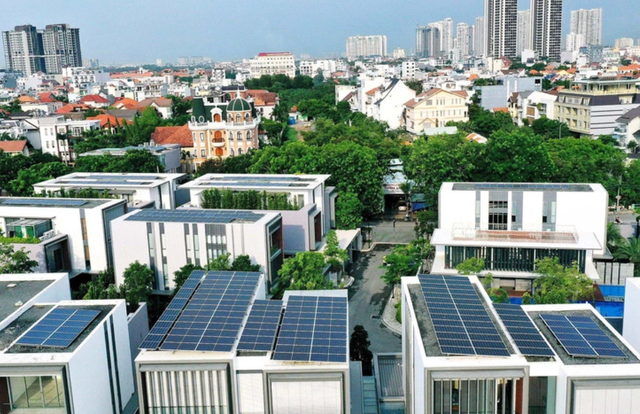
The capital city will strongly promote investment in centralized solar power projects and implement widespread rooftop solar installation at industrial parks, high-tech zones, industrial clusters, office buildings, apartment complexes, high-rise buildings, mixed-use commercial–service–residential buildings, and private homes across the city.
By 2030, about 280 MW of electricity in the capital city will be generated from waste.
The plan also sets a target to save 8-10 percent of the city's total energy consumption while promoting greater use of high-efficiency, energy-saving equipment and machinery, energy audits, and stronger measures to reduce electricity usage and emissions at industrial parks, factories, and urban areas.
In addition, oil reserves are expected to reach approximately 90 days of net imports. The city will develop adequate infrastructure for importing liquefied natural gas (LNG) to meet the demands of LNG power plants and other needs.
Ha Noi also aims to reduce greenhouse gas emissions from energy activities by about 15-35 percent compared with the business-as-usual scenario, while ensuring economic growth of at least 11 percent in 2026 and the following years.
The city will develop an efficient smart grid system capable of safely interconnecting with the region; ensure safe power supply.
Ha Noi will focus on completing the transition to a unified 22 kV medium-voltage grid and undergrounding all of medium- and low-voltage power lines in wards, central areas, and urban zones with stable planning.
By 2045, the city aims to firmly ensure national energy security and develop a transparent, efficient, and equitable energy and electricity market in line with a socialist-oriented market economy.
Although the capital does not enjoy as many hours of sunshine as the central or southern provinces, with more than 1,500–1,800 hours per year, Ha Noi still has significant potential to develop rooftop solar power, especially in new urban areas, industrial zones and other locations with favorable installation conditions.
Making use of existing rooftops not only helps reduce electricity bills but also eases pressure on the grid during peak hours, especially on hot sunny days.
According to calculations by several installation and research units, each 1kWp of rooftop solar can generate an average of 3.5–4.5kWh per day. A 5kWp system produces more than 150kWh per month, equivalent to the typical electricity consumption of an average household in Ha Noi.
In addition to its economic benefits, rooftop solar power helps reduce greenhouse gas emissions. It is estimated that each kWh of solar electricity produced cuts CO₂ by about 0.7kg compared to electricity generated from fossil fuels./.