
General Secretary: State economy must become "national fulcrum" in new era
VGP – State economy must occupy strategic command peaks of the national economy, play the leading role, and become the "national fulcrum" in the nation's new era, said General Secretary To Lam.
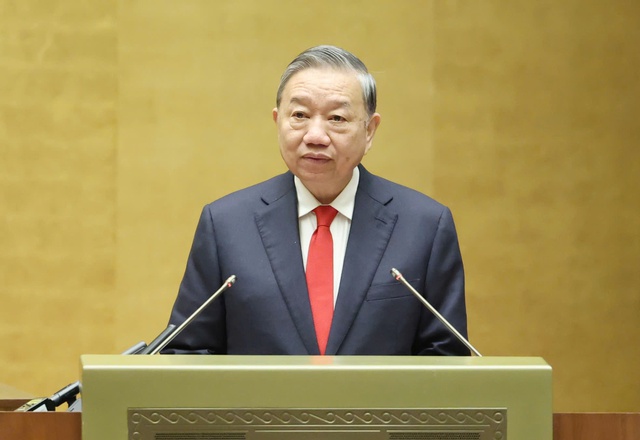
General Secretary To Lam
The Party leader stressed the point in his speech delivered at the national video conference held on February 25 to disseminate the major contents of the Politburo's Resolution No. 79 on State economy development.
In recent years, State economy along with private economy have become the two important pillars of the socialist-oriented market economy. The private economic sector has developed in an increasingly dynamic manner, making significant contributions to growth. Many private enterprises have gradually participated increasingly deeper into regional and global value chains.
Meanwhile, the State economic sector has maintained its leading role, ensured the major balances of the economy and macro stability, and carried out long-term and medium-term strategic tasks directly related to energy security, monetary-financial security, telecommunication security, essential infrastructure development, and other vital tasks of the national economy.
In order to ensure that the State economy truly occupies "strategic command peaks", this sector must be vigorously restructured and focus on key industries and fields, and key areas.
The leading role of the State economy must be demonstrated through leadership capacity, effectiveness, and substantial contributions to macroeconomic stability, economic security and medium- and long-term development.
The State must firmly and effectively control and strengthen the sectors that are necessary to ensure sovereignty and stability.
In sectors where the State should only play a leading role-create foundations-pay the ways, mechanisms must be designed to allow the private sector to participate, compete, and develop together.
In sectors where the State's involvement is unnecessary or ineffective, a resolute restructuring must be implemented according to market principles, ensuring transparency, combating "interest groups," "behind-the-scenes dealings," "manipulation," and "profiteering" from policies.
The State economy must make groundbreaking contributions to enhancing national autonomy and maintaining stability and take timley interventions when systemetic risks arise.
Given the above perspective, the State economy must truly become the following "five fulcrums" over the next five years:
First, fulcrum for economic security and sovereignty. The State economy must hold and control the nation's "lifelines" and "backbone" of the economy, from energy, strategic infrastructure, finance and credit, key logistics, data, and essential digital platforms, among others.
Control here does'nt mean securing monopoly, but ensuring sovereignty, avoiding dependence, proactively responding to changes, and safeguarding national interests in all situations.
Second, fulcrum for regulation, stability and resilience. Particularly, during periods of multiple shocks such as supply chain disruptions, interest rate and exchange rate fluctuations, trade wars, natural disasters and epidemics, the State economy must play a role in stabilizing essential markets, ensuring the provision of essential public services, maintaining foundational investments and reserve capacity to respond promptly to systemic risks.
Thirdly, fulcrum for private sector. Strong State economy is not meant to dominate, but rather to act as a "boost" for private enterprises to participate more deeply in the value chain and development of supporting industries in order to enhance competitiveness on regional and global scales.
If the State economy plays its leading role well, the private sector will have a solid foundation for sustainable growth, and the overall strength of the economy will increase significantly.
Fourth, fulcrum leading innovation and core technologies. If the State economy is strong only in capital and assets but weak in technology, management, and human resources, it cannot maintain its leading role in the new era. Today's leading role is not measured solely by scale, but by the ability to master technology, standardize according to international standards, utilize data as a strategic resource, ensure cybersecurity, and manage risks with modern methods.
Fifth, fulcrum for governance standards and integrity in the economy. State-owned enterprises must exhibit the highest level of discipline, transparency, and accountability.
The existence of "group interests," "backroom deals," investments based on term limits, and prolonged losses without clear accountability cannot be tolerated.
These five "fulcrums" must be translated into concrete action programs with clear objectives, measurable metrics, deadlines, monitoring mechanisms, and sanctions. Otherwise, the leading role of the State economy will remain merely a slogan, while the country will pay the price with wasted resources, diminished competitiveness, and eroded social trust./.