ASEAN, Australia should enhance cooperation to strengthen regional supply chains
VGP - ASEAN and Australia should strengthen regional supply chains, particularly in strategic sectors such as critical minerals, semiconductors, and food, said Prime Minister Le Minh Hung.
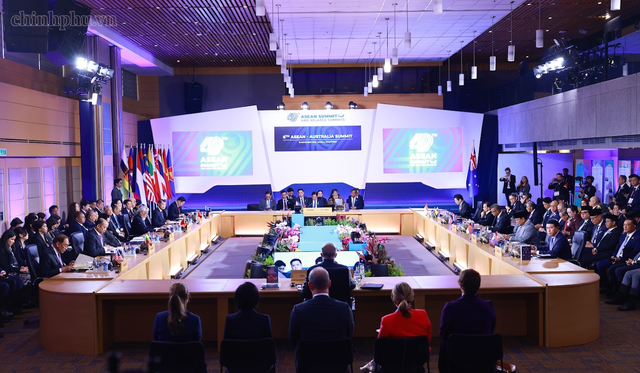
The 6th ASEAN-Australia Summit takes place in Manila, the Philippines on November 16, 2026. Photo: VGP
Prime Minister Le made the above statement while addressing the 6th ASEAN-Australia Summit in Manila, the Philippines on November 16.
At the summit, leaders from ASEAN Member States and Australia noted that ASEAN–Australia relations have continued to achieve important and substantive progress across all areas.
In 2025, the two-way trade reached US$97.28 billion, while foreign direct investment (FDI) inflows from Australia into ASEAN stood at US$1.6 billion.
Australia has implemented numerous practical cooperation initiatives and programs to support ASEAN's Community-building efforts, facilitate trade, advance digital transformation, train skilled labor, and strengthen sub-regional cooperation.
Australia has also actively participated in and contributed to ASEAN-led regional frameworks and mechanisms, reaffirming its commitment to ASEAN centrality.
The leaders affirmed that the ASEAN Community Vision 2045, the ASEAN–Australia Leaders' Vision Statement – "Partners for Peace and Prosperity" (adopted in 2024), and the Melbourne Declaration – "A Partnership for the Future" (adopted in 2024) continue to serve as foundational documents setting out the principles and directions for bilateral cooperation.
Looking ahead, the leaders concurred to continue the effective implementation of the ASEAN–Australia Plan of Action for 2025–2029, alongside agreed programs and initiatives.
Both sides pledged to continue giving high priority to cooperation in addressing non-traditional security challenges—particularly transnational crime, online scams, cybersecurity, and maritime security—while deepening economic connectivity through the effective implementation of the newly upgraded ASEAN–Australia–New Zealand Free Trade Area (AANZFTA) and the Regional Comprehensive Economic Partnership (RCEP).
The two sides also agreed to strengthen cooperation in ensuring energy and food security and enhancing regional resilience against supply chain disruptions, while expanding cooperation in digital economy, energy transition, critical minerals, science and technology, and artificial intelligence, among others.
Australian Prime Minister Anthony Albanese affirmed that Australia remains a reliable and steadfast partner of ASEAN and will actively participate in and contribute to ASEAN-led mechanisms to promote dialogue, build trust, prevent conflict, and maintain regional peace and stability.
Australia will continue its efforts to boost trade and investment and effectively tap into cooperation opportunities in clean energy, digital economy, artificial intelligence, climate change response, infrastructure development, education, and people-to-people exchanges.
Addressing the summit, Vietnamese Prime Minister Le Minh Hung welcomed the important and substantive strides in the ASEAN–Australia Comprehensive Strategic Partnership and affirmed Viet Nam's support for the adoption of the Joint Statement Commemorating the 5th Anniversary of the ASEAN–Australia Comprehensive Strategic Partnership.
Looking ahead, Prime Minister Le proposed three strategic priorities for the ASEAN–Australia Comprehensive Strategic Partnership.
First, ASEAN and Australia should work together to consolidate a peaceful, secure, and stable environment on the basis of international law.
He suggested that both sides coordinate in promoting proactive mechanisms for prevention, early warning, crisis management, and conflict prevention.
Regarding the East Sea, Le commended Australia's support for ASEAN's principled stance and called on both sides to continue coordination to ensure maritime security, safety, and freedom of navigation and overflight, uphold the peaceful settlement of disputes in accordance with international law, particularly the 1982 United Nations Convention on the Law of the Sea (1982 UNCLOS).
Second, ASEAN and Australia should effectively utilize the upgraded AANZFTA and strengthen regional supply chains, particularly in strategic sectors such as critical minerals, semiconductors, and food, said Prime Minister Le.
He urged both sides to make science, technology, innovation, and digital transformation new driving forces, coordinate in implementing the ASEAN Digital Economy Framework Agreement (DEFA), share technologies, develop green infrastructure and renewable energy, and build the ASEAN Power Grid.
Third, ASEAN and Australia should step up cooperation in education and sub-regional development, thereby helping to narrow the development gap and ensuring that all peoples benefit from the fruits of cooperation.
The summit concluded with the adoption of the Joint Statement Commemorating the 5th Anniversary of the ASEAN–Australia Comprehensive Strategic Partnership./.