
THE SOCIALIST REPUBLIC OF VIET NAM
Government News
Work starts on US$5.6 bln high-speed railway project linking Ha Noi and Quang Ninh
VGP - Construction began on the US$5.6 billion high-speed rail project linking Ha Noi and Quang Ninh.
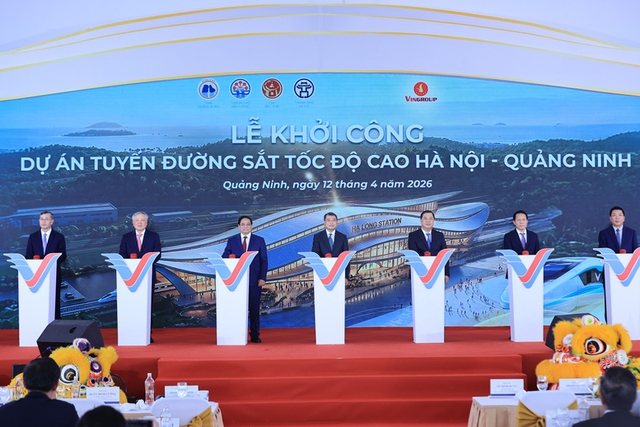
Prime Minister Le Minh Hung (4th from left) at the groundbreaking ceremony of the Ha Noi–Quang Ninh high-speed railway project, Quang Ninh province, April 12, 2026 - Photo: VGP/Nhat Bac
Viet Nam broke ground on the Ha Noi–Quang Ninh high-speed railway on April 12, aiming to reduce travel time between the two localities to just 23 minutes—five to seven times faster than current options.
This is the nation’s first inter-regional high-speed rail link. The project is being developed by VinSpeed High-Speed Rail Investment and Development JSC, a subsidiary of Vingroup, with a total investment of over VND147 trillion (approximately US$5.6 billion), excluding land clearance costs.
The project is scheduled for completion by the end of 2028. It will span 120.2 km, passing through four provinces and cities: Ha Noi, Bac Ninh, Hai Phong, and Quang Ninh.
Designed to meet international standards, the line will feature double tracks with a 1,435 mm standard gauge and will be fully electrified. While the train is designed for a maximum speed of 350 km/h, the section passing through Ha Noi will be restricted to 120 km/h.
Once operational, travel time between Ha Noi and Quang Ninh is expected to be reduced to just 23 minutes—five to seven times faster than current travel options. The route will begin at Co Loa Station (Ha Noi) and terminate at Ha Long Station (Quang Ninh). It will include three intermediate stations: Gia Binh (Bac Ninh), Ninh Xa (Hai Phong), and Yen Tu (Quang Ninh), along with a primary maintenance depot located at the Ha Long terminus.
The project will utilize the latest generation of high-speed trainsets, as well as advanced signaling and technical systems provided by Siemens Mobility. As part of the partnership, Siemens has committed to a phased technology transfer to VinSpeed, with the long-term goal of developing a domestic high-speed rail industrial ecosystem in Viet Nam.
Deputy Secretary of the Quang Ninh Provincial Party Committee and Chairman of the provincial People’s Committee Bui Van Khang described the project as a “mega-project” carrying high expectations. It reflects both the investor’s strong capacity and commitment, as well as the increasingly significant role of the private sector in developing the country’s critical infrastructure.
Nguyen Viet Quang, Vice Chairman and CEO of Vingroup, stated that the project’s groundbreaking underscores the group’s determination to contribute to infrastructure development and gradually build a modern, internationally standardized transport system, thereby supporting socio-economic growth and improving quality of life./.