THE SOCIALIST REPUBLIC OF VIET NAM
Government News
Vietnamese dairy industry to go green
VGP - Deputy Prime Minister Bui Thanh Son has approved the strategy on dairy industry development through 2030, with a vision towards 2045.
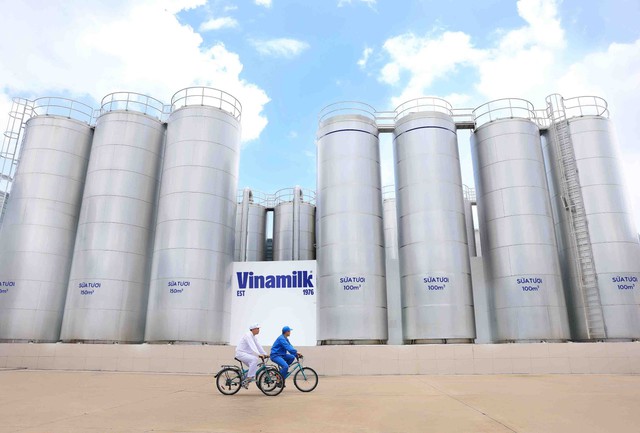
Viet Nam Dairy Products Joint Stock Company - Vinanmilk is the largest dairy producer in Viet Nam and one of the leading dairy companies in Asia - Illustration photo
The strategy aims to build a sustainably developed dairy processing industry with a complete value chain, from dairy herd development and increased raw milk output to high value-added processed products.
The industry is also expected to largely meet rising domestic demand while integrating more deeply into regional and global dairy value and supply chains.
Growth targets through 2045
Under the strategy, by 2030, the dairy industry is projected to grow by 12–14 percent annually. Processed liquid milk output is expected to reach about 4.2 billion liters per year, while domestic fresh milk production is forecast at roughly 2.6 billion liters, meeting 60–65 percent of processing demand.
Milk powder output is projected to grow by 7–8 percent annually to around 245,000 tons, with per capita milk consumption reaching about 40 liters per year.
By 2045, the industry is expected to grow by 5–6 percent annually. Processed liquid milk output is projected at approximately 9.7 billion liters, domestic fresh milk production at about 8 billion liters, meeting 80–85 percent of processing demand. Milk powder output is forecast at around 415,000 tons, while per capita milk consumption is targeted at about 100 liters per year.
Building a safe and sustainable dairy value chain
The strategy aims to develop a safe, sustainable dairy value chain aligned with international standards. It focuses on expanding Viet Nam's dairy herd to increase domestic raw milk supply, reduce import dependence, and modernize agriculture through large-scale farms combined with cooperative and household models.
Product diversification will be strengthened alongside improvements in quality, packaging and design, with greater application of digital technologies, blockchain and AI to enhance productivity, traceability and efficiency. Priority will be given to high value-added products such as specialized formula milk, while school milk programs will use fresh milk and prioritize disadvantaged children.
The strategy encourages innovation, investment in energy-efficient and environmentally friendly production technologies, and the development of integrated value-chain projects that ensure food safety and environmental compliance.
It also promotes the formation of large-scale dairy enterprises and stronger linkages among farmers, processors and businesses to improve competitiveness, stabilize the market and enhance the global position of Vietnamese dairy brands.
The strategy aims to promote sustainable development and green the dairy processing industry by encouraging the adoption of advanced processing technologies; conducting life cycle assessments (LCA); developing green labels and eco-labels for dairy products; and prioritizing “Cleaner Production” technologies.
It also emphasizes in-depth investment, technological and equipment upgrades, pollution prevention, waste reduction, and minimizing the generation of environmentally harmful waste. These efforts are to be combined with end-of-pipe treatment solutions to ensure that no environmental pollution occurs.
In addition, the strategy calls for the application of circular economy models in both raw milk production and dairy processing.
Currently, Viet Nam has only 3.3 dairy cows per 1,000 people, which is one third of Thailand and Japan, half of South Korea, one-fourth of Israel, and only one-26th of the Netherlands. With its natural and economic conditions, Viet Nam is actually better positioned for dairy farming than Japan or Israel. By 2030, the dairy herd could increase four to five times, reaching 1.3 to 1.5 million cows and producing 4.3 to 5 million tons of raw milk./.