THE SOCIALIST REPUBLIC OF VIET NAM
Government News
Viet Nam’s contributions to UN after nearly 50 years of membership
VGP - Nearly 50 years after joining the United Nations (UN), Viet Nam has transformed from a country receiving assistance to overcome the consequences of war and rebuild the nation into an active contributor to the UN’s common work, making increasingly substantive contributions in peacekeeping, human rights protection, sustainable development, and the formulation of global norms and initiatives.
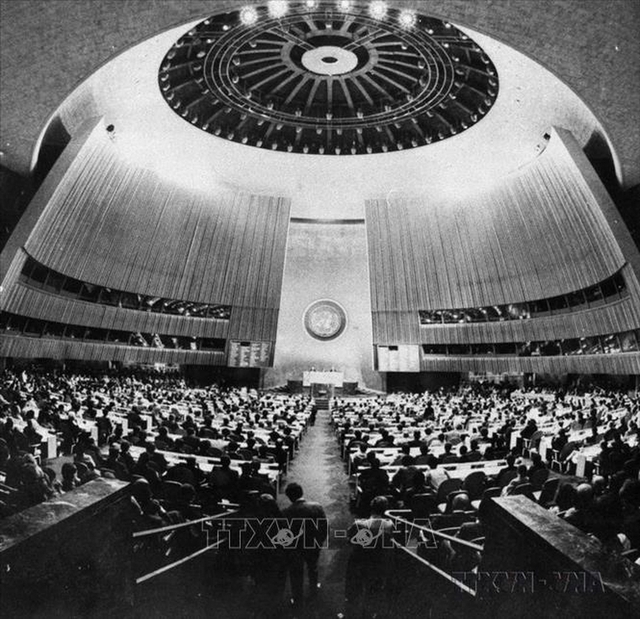
The 32d General Assembly approves the admission of Viet Nm to the United Nations with a record number of 105 countries co‐sponsoring its application for membership.
The UN was established on October 24, 1945, and currently has 193 member states. As the central institution of the global multilateral system, the UN serves as a forum for countries to engage in dialogue and negotiations, build consensus, and coordinate efforts to address common challenges, ranging from peace and security, sustainable development and climate change to human rights, health, humanitarian assistance and gender equality.
Over the past more than 80 years, the UN has played an important role in maintaining international peace and security, managing and preventing conflicts; promoting the development and codification of international law; advancing decolonization; protecting human rights; and promoting poverty eradication, socio-economic development, healthcare and environmental protection.
At the same time, the UN has provided an inclusive global forum where countries, regardless of their size or level of development, can engage in dialogue, coordinate positions and seek solutions to common challenges.
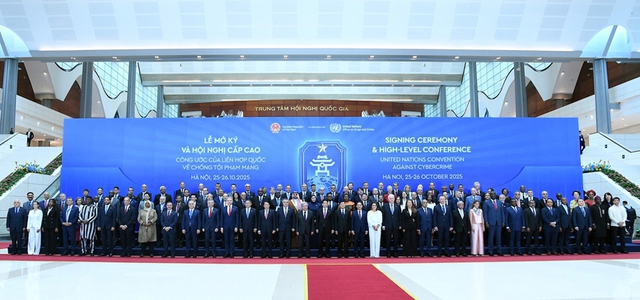
In October 2025, Viet Nam hosted the Signing Ceremony of the UN Convention against Cybercrime in Ha Noi. UN Secretary-General António Guterres attended the event during his second visit to Viet Nam, following his first visit in 2022.
Viet Nam increasingly engages in UN's operation
Viet Nam officially joined the UN on September 20, 1977. In the first years after national reunification, UN agencies and organizations actively supported Viet Nam in overcoming the consequences of war, restoring and rebuilding the country, and improving people's living conditions.
Viet Nam's increasingly active and proactive engagement at the UN has contributed to deepening its foreign relations, both multilaterally and bilaterally; expanding access to international knowledge, standards and resources in support of the country's renewal, sustainable development and strategic priorities; while creating multilateral space to protect and promote national interests by peaceful means and strengthen institutional and governance capacity.
Viet Nam has increasingly engaged in and made substantive contributions to the UN's common work, covering peacekeeping, human rights protection, humanitarian assistance, sustainable development and responses to global challenges, while gradually becoming involved in the formulation of the organization's rules, norms and agenda.
Viet Nam has served twice as a non-permanent member of the UN Security Council, for the 2008-2009 and 2020-2021 terms; three terms as a member of the UN Human Rights Council, for 2014-2016, 2023-2025 and 2026-2028; and two terms on the UN Economic and Social Council (ECOSOC), for 1998-2000 and 2014-2016. Viet Nam also served as a Vice President of the 77th session of the UN General Assembly.
The Southeast Asian nation has also participated in UNESCO bodies, the International Law Commission for the 2017-2022 and 2023-2027 terms, and the Legal and Technical Commission of the International Seabed Authority for the 2023-2027 term.
In 2025, Viet Nam, for the first time, assumed the presidency of the 35th Meeting of States Parties to the UN Convention on the Law of the Sea (UNCLOS). In 2026, Viet Nam assumed the presidency of the 11th Review Conference of the Treaty on the Non-Proliferation of Nuclear Weapons (NPT).
Viet Nam has put forward a number of important UN initiatives, including UN Security Council resolutions on women's roles in post-conflict situations (Resolution 1889, 2009) and the protection of essential infrastructure for civilians in armed conflict (Resolution 2573, 2021); UN General Assembly resolutions establishing the International Day of Epidemic Preparedness on December 27 (Resolution A/RES/75/27, 2020), the International Day of Play on June 11 (Resolution A/RES/78/268, 2024), and the International Decade of Culture for Sustainable Development 2027-2036 (Resolution A/RES/80/308, 2026). Viet Nam also initiated the Group of Friends of the 1982 UN Convention on the Law of the Sea (UNCLOS).
In October 2025, Viet Nam hosted the Signing Ceremony of the UN Convention against Cybercrime in Ha Noi. UN Secretary-General António Guterres attended the event during his second visit to Viet Nam, following his first visit in 2022.
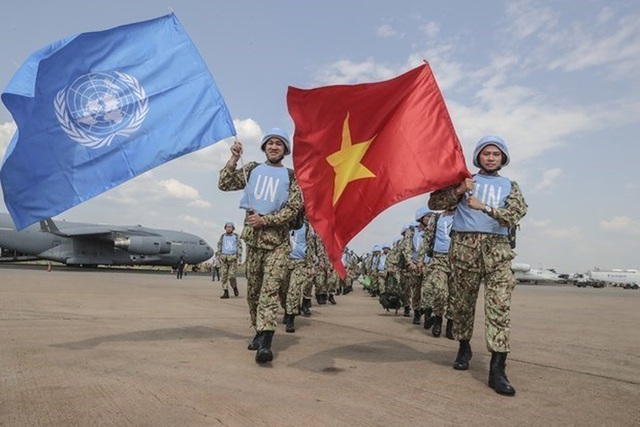
In peacekeeping, Viet Nam has deployed nearly 1,400 officers and personnel to serve in UN peacekeeping missions in South Sudan, the Central African Republic and the Abyei region.
Viet Nam currently ranks 49th among the 193 UN member states in terms of assessed contributions to the UN regular budget. It has also contributed millions of US dollars to humanitarian relief activities carried out by UN agencies.
In the development field, Viet Nam has actively participated in implementing major UN development agendas, particularly the Millennium Development Goals (MDGs), the Sustainable Development Goals (SDGs) and the Paris Agreement on climate change.
Viet Nam was also one of eight pilot countries for the "Delivering as One – One UN" initiative, which aims to enhance the coherence and effectiveness of UN organizations' operations in Viet Nam.
One component of this initiative is the UN Green One UN House in Ha Noi, which was inaugurated during UN Secretary-General Ban Ki-moon's visit to Viet Nam in May 2015. It was the first environmentally friendly common UN house.
Currently, 15 UN agencies have resident representation in Viet Nam, including FAO, IFAD, ILO, IOM, UN Women, UN-Habitat, UNAIDS, UNDP, UNEP, UNESCO, UNFPA, UNICEF, UNIDO, UNODC and WHO.
UN organizations in Viet Nam have actively supported resource mobilization, policy advice, knowledge provision, experience sharing and capacity building, achieving notable results in areas such as education, poverty reduction, green growth, labor, healthcare, social protection and digital transformation.
Towards 50 years of Viet Nam-UN relations
As Viet Nam approaches the 50th anniversary of its accession to the UN in 2027, the two sides will review nearly half a century of cooperation and identify new orientations for Viet Nam-UN relations in the next phase.
UN Resident Coordinator in Viet Nam Pauline Tamesis affirmed that Viet Nam is increasingly moving from a recipient of international cooperation to an active contributor to global solutions through its participation in UN peacekeeping operations, the Human Rights Council, the Security Council and other multilateral mechanisms, as well as its commitments to sustainable development, climate action and artificial intelligence (AI) governance.
Pauline Tamesis said that the UN Sustainable Development Cooperation Framework for Viet Nam for 2027-2031 aims to build a more strategic and mutually beneficial partnership. Areas with further cooperation potential include responsible digital transformation and AI governance, a just energy transition, climate action and resilience-building, while dynamically combining economic development with social inclusion and environmental sustainability.
According to the UN Resident Coordinator, amid increasing geopolitical fragmentation, countries capable of promoting dialogue, building trust and seeking common ground are becoming increasingly important. She said Viet Nam has an opportunity to contribute further, not only by participating in multilateral institutions but also by helping shape solutions, norms and standards for the common future./.