
THE SOCIALIST REPUBLIC OF VIET NAM
Government News
Viet Nam to prioritize funding for strategic, core technologies
VGP - Prime Minister Le Minh Hung has stressed the need to prioritise resources and increase the proportion of spending on strategic, high-tech, and core technologies within the State budget for science, technology, innovation, and digital transformation.
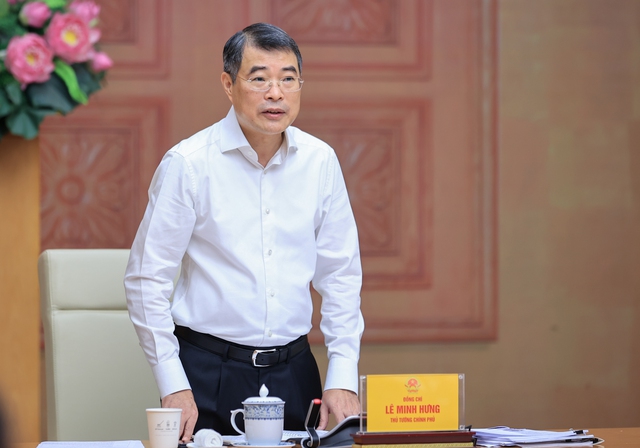
Prime Minister Le Minh Hung at the working session with the Ministry of Science and Technology, Ha Noi, April 22, 2026. Photo: VGP
Speaking at a working session on April 22 with the Ministry of Science and Technology, the Government leader said that, in line with the Politburo’s Resolution 57 on science, technology, innovation, and digital transformation, at least 3% of total annual State budget expenditure should be allocated to these sectors.
Reports at the meeting showed that in 2025 and the first quarter of 2026, the ministry had advised the issuance of 10 laws and one resolution, along with 35 decrees and 60 decisions. It also identified 11 groups of strategic technologies comprising 35 key technology products.
Last year, Viet Nam recorded 53 sci-tech organisations reaching regional and international standards, alongside six high-tech parks. High-tech exports accounted for nearly 50 percent of total exports. The country ranked 44th out of 139 economies in the Global Innovation Index, while its startup ecosystem stood 55th globally.
By the end of March 2026, 5G network coverage reached 91.9 percent of the population, with over 22.4 million subscribers. Viet Nam ranked 14th globally in mobile internet speed and 9th in fixed broadband speed, while its IPv6 infrastructure ranked 7th worldwide.
Progress has also been evident in the development of the digital government, digital society, and digital economy. The number of digital technology enterprises rose sharply, with an additional 1,394 firms established. Exports of digital technology products were estimated at over 45 billion USD, while total export turnover reached approximately US$172 billion. Meanwhile, the e-commerce market expanded to 36 billion USD, three times its 2020 size.
The total State budget allocated to science, technology, innovation, and digital transformation this year stands at VND65.02 trillion (US$2.47 billion). To date, 92.27 percent of recurrent expenditure and 68.58 percent of investment spending have been disbursed, with the remainder under review.
Concluding the session, the Prime Minister acknowledged the ministry’s efforts while pointing out several shortcomings. Looking ahead, he called for a shift in governance thinking from input-based support for enterprises to output-based mechanisms, alongside the removal of bottlenecks through controlled risk acceptance, mastery of core technologies, and effective management of digital assets and digital currencies.
Highlighting the importance of accelerating digital transformation, particularly in the digital economy, he set targets for the sector to account for 30 percent of GDP and for over 40 percent of enterprises to engage in innovation activities.
The leader also directed the ministry to urgently submit, within April, three decrees and two prime ministerial decisions guiding the implementation of the laws on digital transformation and on artificial intelligence. It was also tasked with reviewing and finalising the list of strategic technologies and products.
In addition, the ministry must coordinate with the Ministry of Finance to complete guidelines on criteria, procedures, and funding mechanisms for science, technology, innovation, and digital transformation projects. This includes transitioning from direct budget allocation to an order-based mechanism tied to outcomes, as well as establishing controlled regulatory sandbox frameworks for research.
By the second quarter of 2026, the ministry is required to work with relevant agencies to draft a resolution on a new development model for the country based on science, technology, innovation, and digital transformation, for submission to the Party Central Committee.
Le further called for a comprehensive restructuring of research infrastructure and the innovation ecosystem, including reforms to 16 key national laboratories, the introduction of breakthrough mechanisms for science and technology exchanges, and enhanced support for intellectual property valuation and registration.
He also urged the swift establishment of criteria for recognising innovation centres and innovative enterprises, with completion targeted for May 2026./. VNA