THE SOCIALIST REPUBLIC OF VIET NAM
Government News
Viet Nam prioritizes deep processing in rare earth development
VGP - Party General Secretary and President To Lam called for the development of Viet Nam’s materials industry with a focus on deep processing, technological mastery and sustainable growth, stressing that the country must neither export raw resources nor sacrifice the environment for economic gains.
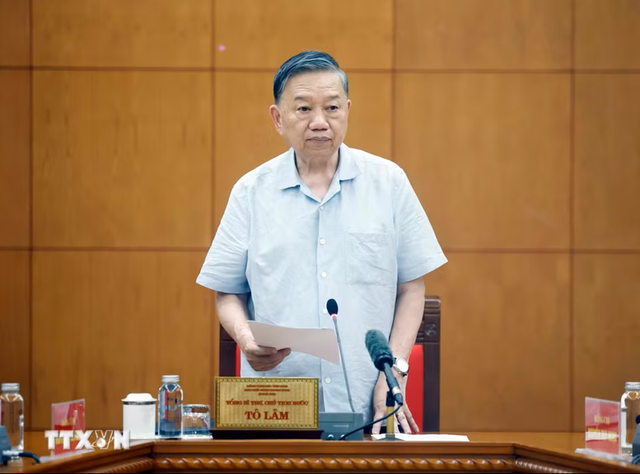
The requests made the call during a working session with the Central Commission for Policies and Strategies and representatives from ministries and agencies to discuss orientations for the development of the national materials industry, in Ha Noi on May 21.
To Lam assigned the Government's Party Committee to promptly formulate a strategy for developing Viet Nam's materials industry through 2030, with a vision toward 2045.
He identified five priority sectors for immediate focus, including rare earth materials, semiconductor materials, battery and energy storage materials, new materials, and next-generation construction materials. According to him, these sectors play a vital role in the country's industrialization, modernization and economic self-reliance, requiring clear priorities, roadmaps and support policies.
To Lam also emphasized the need to modernize traditional material industries in a greener, more technology-intensive and higher value-added direction. In addition, he called for stronger breakthroughs in science and technology, standards and testing systems, and high-quality human resources development. Other priorities include promoting Vietnamese enterprises, expanding the domestic market for green and strategic materials, improving institutions, strengthening coordination among agencies, enhancing supervision, and protecting national interests amid international integration.
In recent years, Viet Nam's materials industry has achieved notable progress, particularly in sectors such as steel, cement, construction materials, chemicals, fertilizers, plastics, rubber, textiles and wood processing. The country also holds considerable reserves of rare earths, bauxite, titanium, tungsten, graphite, silica sand and limestone.
At the same time, emerging industries involving green and recycled materials, semiconductors, batteries, renewable energy, biomedical materials and composites are gaining momentum.
Despite these advances, the industry continues to face major challenges. High-quality products remain limited, deep processing capacity is still weak, and some large-scale industries continue to consume substantial energy and generate high emissions. Although foreign direct investment has grown, linkages between foreign-invested and domestic enterprises remain limited, while commercialization efforts have progressed slowly. Viet Nam also continues to rely heavily on imports for many essential materials./.