THE SOCIALIST REPUBLIC OF VIET NAM
Government News
Viet Nam moves up one place in Global Innovation Index 2026
VGP - Viet Nam ranks 43rd among 139 economies in the Global Innovation Index (GII) 2026, moving up one place from 2025, according to the latest report released by the World Intellectual Property Organization (WIPO).
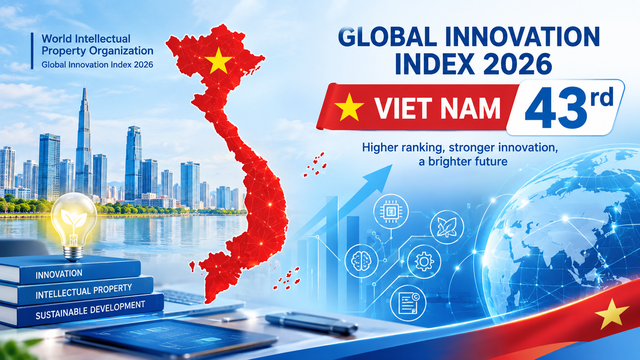
Viet Nam ranks 43rd among 139 economies in the Global Innovation Index (GII) 2026, moving up one place from 2025 - Photo with AI support
The ranking continues Viet Nam's steady improvement in global innovation performance. Over the past decade, the country has climbed 16 places, from 59th in 2016 to 43rd in 2026.
Viet Nam ranks second among 36 lower-middle-income economies and third in ASEAN, after Singapore and Malaysia. Its innovation output ranking rose two places to 35th, from 37th in 2025.
WIPO also identifies Viet Nam as one of seven middle-income economies that have recorded the fastest improvement in GII rankings since 2013, alongside China, India, Türkiye, the Philippines, Morocco and Indonesia.
The country is also among three economies whose innovation performance is above expectations for their level of development, together with China and India. Viet Nam has maintained this above-expectation performance for 16 consecutive years.
In 2026, Viet Nam maintained particularly strong performance in several innovation-related indicators. The country ranked first globally in the share of high-tech exports and the share of creative goods exports.
Viet Nam also ranked third in high-tech imports, fifth in smartphone app creation and sixth in labor productivity growth. Business-funded research and development (R&D) expenditure accounted for another strong area, with Viet Nam ranking 13th globally.
According to the WIPO report, in 2026, Viet Nam continued to improve its innovation output ranking, moving up two places from 37th in 2025 to 35th. This improvement contributed to a one-place rise in Viet Nam’s overall ranking to 43rd, enabling the country to achieve the target set by the Government in Resolution No. 02/NQ-CP, dated January 8, 2026 on major tasks and solutions to improve Viet Nam's business environment and sharpen national competitiveness.
Viet Nam continued to rank second among lower-middle-income economies, behind India, which ranked 38th. In addition, two upper-middle-income economies ranked ahead of Viet Nam: China in 10th place and Malaysia in 34th. All other economies ranked above Viet Nam were developed, high-income economies.
Within ASEAN, Viet Nam maintained its third position, behind Singapore and Malaysia, and ahead of Thailand, thereby exceeding the target set by the Government in Resolution No. 01/NQ-CP for 2026.
In its GII 2026 report, WIPO recognized Viet Nam as one of the seven middle-income economies that have improved their rankings most rapidly since 2013, alongside China, India, Türkiye, the Philippines, Morocco and Indonesia.
Viet Nam was also among the three economies whose innovation performance was considered outstanding relative to their level of development, together with China and India. For 16 consecutive years, Viet Nam has recorded innovation performance above the level expected for its development, demonstrating its effectiveness in transforming innovation inputs and resources into innovation outputs.

Minister of Science and Technology Vu Hai Quan
Minister of Science and Technology Vu Hai Quan described the two-place improvement in Viet Nam's innovation output ranking as a notable result.
He attributed the progress partly to the country's strong efforts to implement Resolution No. 57-NQ/TW on breakthroughs in science and technology, innovation and national digital transformation over the past year.
According to the Minister, investment in science and technology, innovation and digital transformation has increased significantly, while the participation of the State, businesses, research institutions and universities has contributed to the development of an increasingly comprehensive innovation ecosystem.
These efforts, he said, have been reflected in Viet Nam's innovation performance.
Despite the improvement in innovation outputs, the GII 2026 results also point to areas requiring further attention, particularly human resources and research capacity. Viet Nam's ranking in the human capital and research pillar fell from 70th to 79th. Education expenditure as a share of GDP ranked 112th, while the student-teacher ratio ranked 106th and the graduation rate in science and technology ranked 65th.
The Minister stressed the need to improve the quality of human resources, particularly highly qualified personnel serving strategic technology industries, including through stronger postgraduate education.
He also called for greater efforts to increase international scientific publications and patent applications, which are important indicators of a country's research and innovation capacity.
In GII 2026, Viet Nam ranked 106th in scientific and technical articles, while patent applications by country of origin improved by three places to 63rd.
The stronger participation of businesses in research, development and innovation will be particularly important in the coming period, Minister Vu Hai Quan said.
Vietnamese businesses need to increase investment in both financial and human resources, while gradually integrating advanced technologies and digital transformation into production and business operations to improve product quality, create greater value and raise labor productivity.
The GII 2026 results show several positive developments in business-related innovation indicators. University-business cooperation improved by seven places to 24th, while the number of researchers employed by businesses rose two places to 49th.
At the same time, Viet Nam's overall innovation input ranking declined from 50th to 54th. The institutions pillar fell from 59th to 64th, infrastructure from 56th to 59th, and business sophistication from 45th to 48th.
The Minister emphasized that deeper business engagement in innovation, R&D and technology adoption will be essential for Viet Nam to achieve its long-term innovation objectives.
Towards Top 40 by 2030 and top 30 by 2045
Under the Strategy for Science, Technology and Innovation Development to 2030, Viet Nam aims to rank among the world's top 40 economies in the GII by 2030.
Resolution No. 57-NQ/TW sets a longer-term target of placing Viet Nam among the world's top 30 countries in innovation by 2045.
To achieve these goals, the Ministry of Science and Technology has identified a number of priorities, including continued institutional reform, greater investment in R&D, and stronger links among businesses, universities and research institutions.
The country will also seek to attract foreign corporations to establish R&D centers in Viet Nam, improve the quality of human resources, mobilize capital for innovative start-ups, and strengthen enterprises' capacity to receive, absorb and master advanced technologies.
The GII 2026 results provide further evidence of Viet Nam's progress in translating innovation inputs into tangible outputs, while highlighting the need to improve the quality and effectiveness of its innovation ecosystem to support sustainable growth and enhance national competitiveness./.