THE SOCIALIST REPUBLIC OF VIET NAM
Government News
Viet Nam, India set new trade goal of US$25 billion by 2030
VGP - General Secretary and President To Lam had a summit meeting with Indian Prime Minister Narendra Modi in New Delhi on May 6 as part of his ongoing high-profile visit to India.
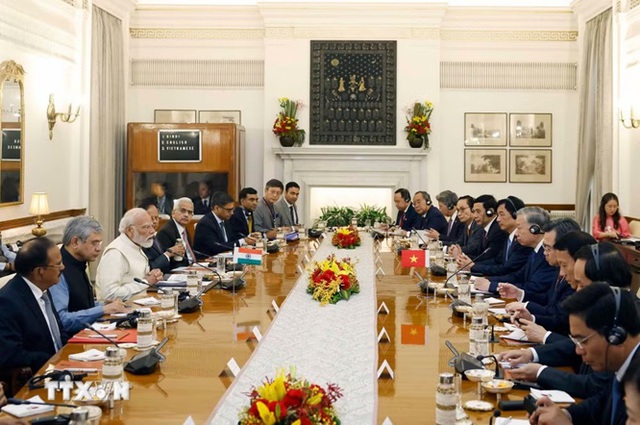
The summit meeting between General Secretary and President To Lam and Indian Prime Minister Narendra Modi, New Delhi, May 6, 2026
To Lam affirmed that Viet Nam always treasures and wishes to further advance its traditional friendship and Comprehensive Strategic Partnership with India, considering it one of the top priorities in its foreign policy of independence, self-reliance, resilience, diversification and multilateralisation in the new period.
He congratulated India on its remarkable development achievements and spoke highly Prime Minister Modi’s leadership and the Bharatiya Janata Party-led coalition Government for elevating India to the world’s fourth largest economy and one of the leading science and technology hubs.
To Lam expressed his belief that India would successfully realise its goal of becoming a developed nation by 2047, with an increasingly prominent role and standing on the global stage.
Prime Minister Modi congratulated General Secretary To Lam on his election as President of Viet Nam by the 16th National Assembly. He stressed that General Secretary and President To Lam's ongoing visit to India after the success of the 14th National Party Congress and the introduction of Viet Nam's lew leadership, carries profound historical significance, particularly in the year that both countries mark the 10th anniversary of their Comprehensive Strategic Partnership.
He reassured that India always considers Viet Nam one of its foremost partners in its “Act East” policy, he said, expressing his belief that Viet Nam would successfully realize its development goals of becoming a modern industrial, upper-middle-income developing country by 2030, and a high-income developed nation by 2045.
Modi said the two countries share common values, vision, and aspirations for independence and self-reliance, alongside a commitment to rules-based world order anchored in international law, which forms a solid base for joint work, mutual support and active contributions to peace, stability and development across the region and beyond.
The two leaders expressed their delight at the robust advancement across multiple areas over the past decade since the Comprehensive Strategic Partnership was established. Political trust has been steadily fostered, while national defence-security ties have deepened into a key strategic pillar. Economic, trade, and investment ties have been growing, with two-way trade rising annually to a new record of US$16.4 billion in 2025. Cultural and people-to-people connectivity remain a bright spot, buoyed by nearly 90 direct flights and growing tourist flows.
The two leaders vowed to fortify the social foundation of bilateral ties by enhancing joint wok in culture, tourism, and people-to-people exchanges, while upholding shared cultural, historical, and religious values. They also underlined the importance of bolstering connectivity in aviation and logistics, as well as among localities and key economic and tech centres.
On global and regional issues, both the host and the guest reaffirmed their commitment to close coordination and mutual support at multilateral forums such as the United Nations and the Association of Southeast Asian Nations (ASEAN), as well as ASEAN-led mechanisms. The Indian side spoke highly of ASEAN’s central role. Both sides stressed the importance of maintaining peace, stability, security, safety, and freedom of navigation and overflight, and settling disputes through peaceful means in accordance with international law, including the 1982 United Nations Convention on the Law of the Sea (UNCLOS 1982).
Following the talks, the leaders witnessed the exchange of cooperation agreements covering sci-tech, critical minerals, healthcare, tourism and culture, finance, cybersecurity, locality-to-locality cooperation, and auditing.
The two leaders agreed to direct relevant ministries and agencies to swiftly and effectively follow the signed agreements, ushering Viet Nam–India relations into a new development stage. Both sides believed that with the shared determination of their leaders and people, bilateral ties will continue to grow stronger, deeper and more substantive, serving the interests of both nations while contributing to peace, stability, cooperation, and development in the region and the world.
On this occasion, General Secretary and President To Lam conveyed greetings from Vietnamese Party and State leaders to Prime Minister Modi and other Indian leaders, and extended an invitation to Modi to visit Viet Nam in the near future./.