THE SOCIALIST REPUBLIC OF VIET NAM
Government News
Viet Nam, Canada strive for US$14-15 bln in bilateral trade value by 2030
VGP - Given the strong growth momentum in Viet Nam-Canada trade in recent years, the two economies could fully work toward reaching a trade volume of US$14–15 billion by 2030, in a more balanced, sustainable manner and with higher added value, noted General Secretary and President To Lam.
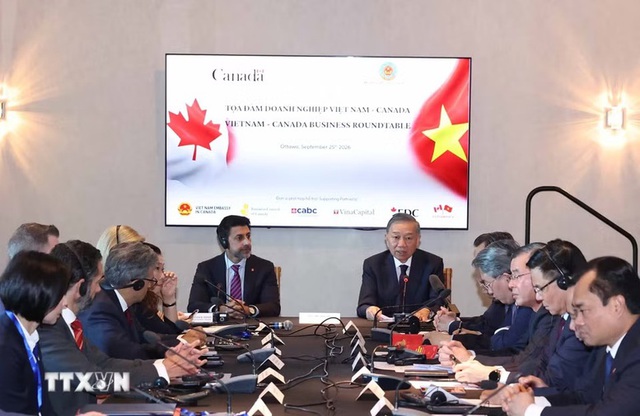
General Secretary and President To Lam attends the Viet Nam-Canada Business Roundtable, Ottawa, September 25, 2026 - Photo: VNA
The top Vietnamese leader made the above statement while addressing the Viet Nam-Canada Business Roundtable held in Ottawa, on September 25, as part of his State visit to Canada.
The event was jointly organized by the Viet Nam's Ministry of Finance and the Global Affairs Canada.
To take the bilateral economic relations to a new stage, with deeper investment, stronger integration of value chains, and more tangible results, To Lam called on the business communities of both countries to focus on shifting from strong trade relations toward stronger investment relations by connecting Canadian long-term capital with high-quality projects in Viet Nam.
The two countries need to expand collaboration in strategically significant areas such as clean energy, LNG, energy technologies, critical minerals, transport and logistics, science, technology, and innovation, he suggested.
To Lam urged Canadian businesses to invest not only in tangible assets but also in technology, research and development, data, digital solutions, clean technologies, and industries capable of increasing the productivity of the economy.
The ultimate goal is not merely to add another facility or another factory. A higher objective is to create new development capabilities for Viet Nam, noted the leader.
The two sides should make full use of the Comprehensive and Progressive Agreement for Trans-Pacific Partnership (CPTPP), moving cooperation beyond conventional trade in goods toward deeper integration in capital, technology, businesses, supply chains, and human resources, underlined To Lam.
High-quality workforce training, knowledge transfer, and skills development should be regarded as integral components of every major investment project, stated To Lam.
To turn these orientations into reality, the General Secretary and President emphasized strong commitments from Viet Nam to continue building a stable, transparent, competitive, and predictable investment and business environment; protecting the legitimate and lawful rights and interests of investors; improving the quality of project preparation and transparency of information; and completing the necessary conditions so that investors can evaluate, mobilize capital for, and implement long-term projects.
Canadian Minister of International Trade Maninder Sidhu affirmed that the recently-signed agreements, together with cooperation activities between businesses from both sides, have created a very solid foundation for trade and investment relations. These achievements provide a basis for the two sides to pursue new opportunities for cooperation in the coming period.
On this occasion, the Vietnamese leader and Minister Sidhu witnessed the signing and exchange of cooperation documents, including:
(1) Strategic cooperation between Viet Nam Airlines and CAE Inc. in aviation training and simulation technology;
(2) Memorandum of Understanding (MoU) between Vietjet and CAE Inc. on strategic cooperation in training of pilots, cabin crew, and technicians, as well as simulation technology and digital learning;
(3) MoU between Vietjet and InteliSys Aviation Systems on long-term strategic cooperation in the modernization of core technology systems, digital transformation, artificial intelligence, data, next-generation aviation retail, and technology platforms to support Vietjet's international development and expansion strategy./.