
THE SOCIALIST REPUBLIC OF VIET NAM
Government News
Viet Nam, Australia partner to advance biomedical RNA technology
VGP - Under the witness of the Consul General of Viet Nam in Sydney, Viet Nam's Tam Anh Research Institute and the RNA Institute at Australia's University of New South Wales (UNSW) signed a Memorandum of Understanding aimed at strengthening RNA research, capacity building and innovation, opening up potential applications in the production of next-generation drugs and vaccines.
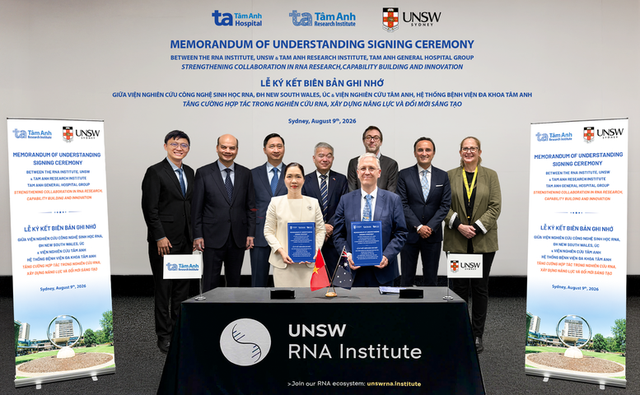
The Memorandum of Understanding (MoU) signing ceremony takes place at the University of New South Wales (UNSW), Australia, in the presence of the Consul General of Viet Nam in Sydney
Foundations for long-term collaboration in RNA technology
The RNA Institute is part of the University of New South Wales (UNSW Sydney), a member of Australia's prestigious Group of Eight (Go8), is a specialized research institution dedicated to RNA science and technology. According to the QS World University Rankings 2027, UNSW ranks 19th globally and first in Australia.
The institute focuses on developing mRNA vaccines against infectious diseases, such as influenza and personalized cancer vaccines, while progressively mastering the RNA technology value chain, which serves as the foundation for many next-generation vaccines, biologics, and therapies.
This is also an area in which the Tam Anh Research Institute has had years of international collaboration, particularly in cancer vaccine and infectious disease vaccine research. The agreement lays the foundation for long-term collaboration in research, human resource training, RNA technology development, preclinical research, clinical trials, and preparation for domestic manufacturing capacity for biomedical products.
The signing took place during the State visit of General Secretary and President To Lam to Australia from August 9-12, as the two countries continue to advance their Comprehensive Strategic Partnership, particularly in science, technology, innovation, and high-quality human resource development.
Nguyen Thanh Tung, Consul General of Viet Nam in Sydney, described the agreement as a concrete step toward advancing Viet Nam-Australia cooperation in strategic science and technology.
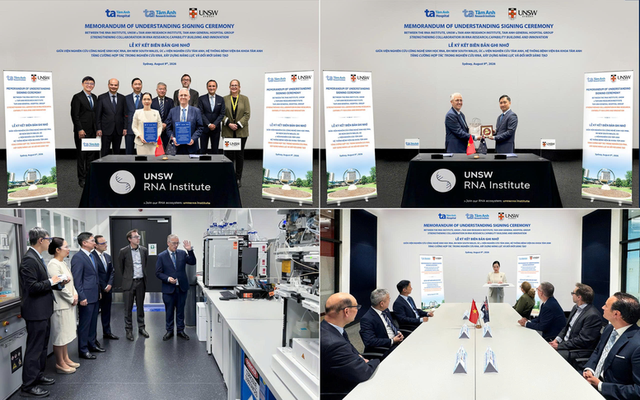
Delegates from the Tam Anh Research Institute working with colleagues and visiting the laboratories and Preclinical Center at the UNSW RNA Institute.
RNA as the core technology for next-generation vaccines and medicines
RNA (ribonucleic acid) is a biological molecule that plays a role in transmitting genetic information within cells. If DNA is considered the "blueprint," RNA acts as the "messenger bringing the blueprint into production," guiding cells to produce the proteins necessary for vital functions. This mechanism makes RNA a core technology platform for many next-generation vaccines, biologics, and therapies.
From the RNA platform, scientists can develop a range of technologies. For example, mRNA is used to develop vaccines and certain therapies; siRNA helps "silence" disease-causing genes; while gRNA supports gene-editing technologies. As a result, RNA is opening up new treatment approaches for cancer, genetic diseases, immune-related diseases, rare diseases, and many other areas of biomedicine.
Professor Pall Thordarson, Director of the UNSW RNA Institute, said Viet Nam has an opportunity to become an important driving force behind the RNA technology revolution in the Asia-Pacific region. The Vietnamese government has demonstrated a clear direction toward developing RNA technology through recent policies, including Prime Ministerial Decision No. 1657/QD-TTg and Politburo Resolution No. 72-NQ/TW.
Combined with Viet Nam's experience in conducting mRNA vaccine clinical trials and the World Health Organization's (WHO) recognition of Viet Nam's vaccine regulatory system as having reached Maturity Level 3, these factors make Viet Nam an attractive partner for Australian researchers.
"The UNSW RNA Institute considers the Tam Anh Research Institute a leading candidate for building a partnership that can create a lasting and meaningful impact on RNA research and technology development in the Asia-Pacific region," Professor Pall said.
Mapping mutation profiles for lung and colorectal cancers in Viet Nam
The value of the partnership extends beyond technology transfer. The two sides will also jointly generate data and solutions tailored to the disease profiles of populations in Viet Nam and Southeast Asia.
"Viet Nam should not remain merely an endpoint for manufacturing. It is fully positioned to become a design and evaluation hub for diseases and populations that have not received sufficient attention from the global research chain," Professor Pall said.
As an initial step, the UNSW RNA Institute has proposed two major program directions: developing an mRNA influenza vaccine and developing personalized cancer vaccine candidates for patients with lung or colorectal cancer. These research directions could create direct value for Viet Nam while expanding the RNA research data and capabilities of both institutions in the Asia-Pacific region.
Dr. Phuong Le Tri, Executive Director of the Tam Anh Research Institute, said this marks the first time Viet Nam has gained access to an end-to-end RNA development model, connecting foundational research, technology development, preclinical evaluation, clinical trials, and preparation for domestic manufacturing capacity.
"Building on the existing capabilities of both sides and Tam Anh's extensive experience, the UNSW RNA Institute believes this partnership will serve as a launchpad for Tam Anh to achieve breakthroughs that even we cannot fully imagine today," Professor Pall said.
Where Viet Nam previously had access primarily to vaccines and biologics only after their technologies had been fully developed, the partnership with the UNSW RNA Institute opens up a "new horizon," enabling domestic scientists to jointly research core technologies from the earliest stages to develop safer vaccines and medicines, progressively master RNA technology, strengthen national health security, and contribute to the global biomedical innovation ecosystem./.