THE SOCIALIST REPUBLIC OF VIET NAM
Government News
Top leader calls for stronger breakthroughs in implementation of Resolution 57
VGP – General Secretary and President To Lam has called for stronger breakthroughs in the implementation of Resolution No. 57-NQ/TW dated December 22, 2024, of the Politburo on breakthroughs in the development of science, technology, innovation, and national digital transformation.
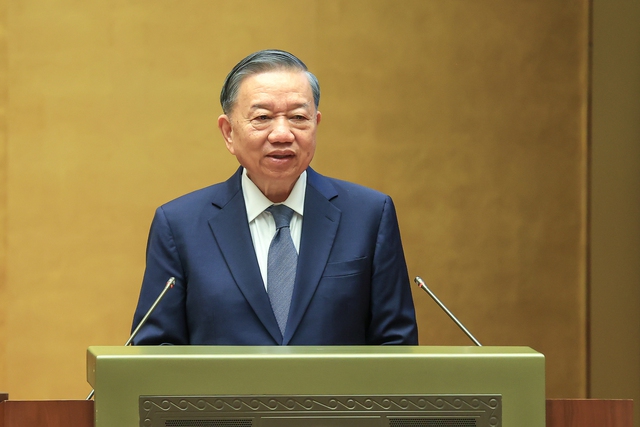
General Secretary and President To Lam addresses the national conference reviewing the 1.5-year implementation of Resolution No. 57-NQ/TW dated December 22, 2024, of the Politburo on breakthroughs in the development of science, technology, innovation, and national digital transformation, Ha Noi, July 1, 2026. Photo: VGP
The top Vietnamese leader made the call on July 1 while addressing the national conference reviewing the 1.5-year implementation of Resolution No. 57.
He frankly pointed out that the biggest bottleneck lies within the implementation phase—which demands a more vigorous breakthrough in the coming time.
While the previous phase focused on laying foundations, the upcoming period must focus on delivering results, said To Lam, adding that Viet Nam must transition decisively from mechanism building to product creation, from task completion to value generation, and from preparing conditions to directly contributing to national development.
Regarding major tasks for the upcoming period, General Secretary and President To Lam emphasized four major requirements.
First and foremost, it is imperative to continue thoroughly grasping Resolution 57 in alignment with the implementation of the Resolution adopted at the 14th National Party Congress.
He emphasized that science, technology, innovation, and digital transformation constitute the primary drivers of the new development and growth model. This is not an optional choice, but an obligatory path to r ealize the country's two centenary goals.
Each party committee, party organization, official, and party member—especially top leaders—must view the execution of the Resolution as their critical and regular political task, rather than a matter exclusive to specialized agencies.
There must be a sharp pivot toward generating specific products, results, and values that directly contribute to the double-digit growth target. Accordingly, leadership must shift from a "task-completion" mindset to an "output-product" mindset.
Tasks under Resolution 57-NQ/TW will only be considered complete when they yield operational products, verifiable data, actual users, and measurable efficiency.
"We must answer with concrete products: which technologies have been mastered, which data systems have been connected, which administrative procedures have been streamlined, which enterprises have scaled up, which sectors have increased productivity, how citizens have benefited, how much society has saved, and how much growth has been contributed," General Secretary and President To Lam specified.
Regarding national digital transformation, alongside focusing on digitalization within the political system, it is vital to accelerate digital transformation across enterprises and society at large, while developing the digital and data economies, said To Lam.
In terms of science, technology, and innovation, the top Party and State leader stressed that national resources must be concentrated on mastering and developing national strategic technologies into concrete products, particularly in artificial intelligence (AI), big data, robotics and automation, biology and biomedicine, materials and energy, semiconductor chips, cybersecurity and quantum computing, unmanned aerial vehicles, as well as marine, ocean, and underground technologies.
Targets must be set for what technologies we will master, what products we will possess, what we will export, and how much we will contribute to economic growth, national defense, security, and national autonomy after 1, 3, 5, and 10 years, said To Lam.
Any ministry spearheading a strategic technology project must bear ultimate responsibility for the final product—not just for compliance with rules and procedures, but for actual outcomes, efficiency, and real-world impact, he added.
Agencies, units, and localities must bear primary responsibility for the security and safety of their own systems.
The General Secretary and President requested that central ministries and agencies genuinely fulfill their roles in facilitating development within their assigned sectors and fields.
They must proactively review and refine institutions, mechanisms, and policies; promptly issue regulations, standards, processes, and master architectures; and dismantle barriers, bottlenecks, and obstacles.
He called on the business community to increase investment in research and development (R&D), technological innovation, digital transformation, and high-quality human resource training, as well as participate in national strategic technology programs.
Enterprises must serve as the center of the innovation ecosystem. Large enterprises, along with state-owned and private economic corporations, need to promote their pioneering and leading roles in mastering core technologies, developing Vietnamese tech products, integrating deeper into global value chains, and forming high-impact innovation ecosystems.
He urged research institutes, universities, and the scientific community tocontinue to leverage their core roles in generating new knowledge, new technologies, and high-quality human resources.
Research institutes and universities need to focus more heavily on the practical problems facing the country, sectors, localities, and enterprises, utilizing the efficacy of application, transfer, and commercialization as key metrics for research performance.
To Lam stressed that it is essential to rectify the situation where research is detached from reality, or where research findings remain shelved or fail to find application addresses.
Simultaneously, stronger policies must be enacted to attract talents, international experts, and overseas Vietnamese intellectuals, thereby forming robust research groups and connecting the global network of Vietnamese intellectuals.
The core focus of international cooperation must shift from merely attracting capital to attracting knowledge, technology, and experts, contributing to enhancing domestic R&D capacity, said the General Secretary and President.
Noting that human resource preparation is a fundamental and long-term task, General Secretary and President To Lam requested that, starting from the upcoming academic year, the education and training sector, higher education institutions, and vocational training centers review their curricula, prioritize strategic technological fields, and accelerate training in digital skills, innovation capacity, and AI application.
Resolution Implementation Outcomes to Serve as a Key Criterion for Cadre Evaluation
Emphasizing the requirement to vigorously innovate leadership, direction, inspection, supervision, and performance evaluation, General Secretary and President To Lam requested that leaders at all levels directly lead, direct, inspect, and take responsibility for the implementation outcomes of Resolution 57. Matters within their authority must be executed proactively; matters beyond their authority must be reported and proposed promptly without waiting, shifting responsibility, or evading duties. The outcomes of Resolution 57 implementation must serve as a key criterion for evaluating cadres.
Stating clearly that the Politburo has decided to increase the ratio of cadres with science and technology qualifications in party committees from 5% to 10–15%, the General Secretary and President requested that central and local party committees and organizations devise training and cultivation plans to prepare a pool of cadres capable of meeting this requirement.
The Politburo has also issued regulations on quarterly cadre evaluations; anyone who fails to meet job requirements must be promptly replaced or reassigned. The Central Inspection Commission and inspection commissions at all levels must actively supervise the implementation of Resolution 57, ensuring that the Party's guidelines are executed strictly and effectively.
Against the backdrop of rapidly accelerating global technological competition, and emphasizing that there is no time to lose, General Secretary and President To Lam noted that the implementation of Resolution 57 must be driven with greater determination and vigor, and most importantly, must be more substantive and effective.
He further requested that, immediately following the conference, members of the Steering Committee, party committees, party organizations, ministries, sectors, and localities directly oversee the review of tasks within their purview. They must clearly identify bottlenecks, root causes, responsibilities, deliverables, and completion deadlines, and urgently concrete them into programs and plans with clear timelines and accountabilities. They must be determined to turn science, technology, innovation, and digital transformation into powerful development drivers for the country in the new era, contributing to making Vietnam develop rapidly, sustainably, powerfully, and prosperously.