THE SOCIALIST REPUBLIC OF VIET NAM
Government News
Tech diplomacy: Major takeaways from To Lam’s visits to Russia and France
VGP - Viet Nam is doubling efforts to leverage foreign relations to improve domestic technology capabilities, Professor Thayer told VNExpress following General Secretary and President To Lam’s visits to France and Russia.
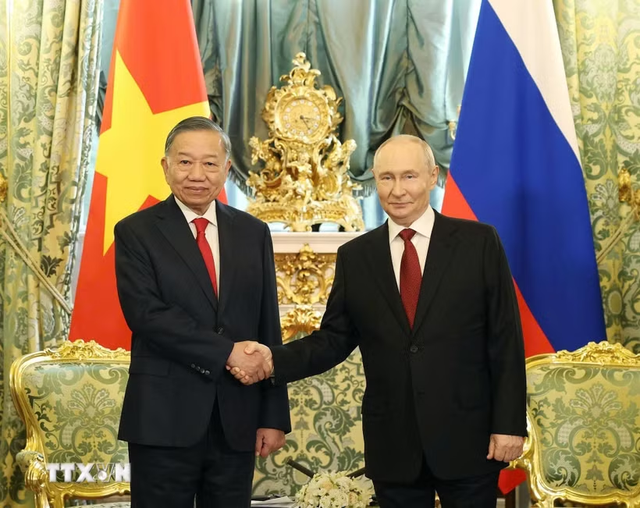
General Secretary and President To Lam (left) meets with Russian President in Moscow, September 9, 2026. Photo: VNA
From September 7 to 12, the General Secretary and President To Lam paid a state visit to Russia, an official visit to France, where he attended the International Space Summit in Paris, during which both Russia and France agreed to identify science and technology as a new breakthrough area in their cooperation with Viet Nam.
Carl Thayer, an emeritus Professor from the University of New South Wales, Australia, describes hallmark of the General Secretary and President To Lam's visits to France and Russia as "strategic technology of diplomacy"
In Russia, General Secretary and President To Lam attended the Viet Nam - Russia Science and Technology Forum. His agenda covered areas including nuclear power, new energy, satellite, space, semiconductor, microelectronics, quantum technology, and artificial intelligence (AI).
The Vietnamese leader called for a shift from mere exchanges and training activities to jointly mastering technologies, co-developing products, transferring technologies and accessing markets.
The visit to France reflects a different focus, namely gaining access to advanced capabilities of Europe while developing human resources and industrial ecosystems.
The agreements reached during the visit covered areas including Earth observation satellites, critical minerals, railway technology training and aviation. The Ha Noi University of Science and Technology and the French Alternative Energies and Atomic Energy Commission (CEA) signed memoranda of cooperation in training and research, as well as technology transfer in nuclear science and technology, new energy, hydrogen energy and semiconductors.
Thayer said this reflects Viet Nam's shift from a diplomacy primarily focusing on trade, investment and political balancing towards a diplomacy that places greater emphasis on enhancing national capabilities.
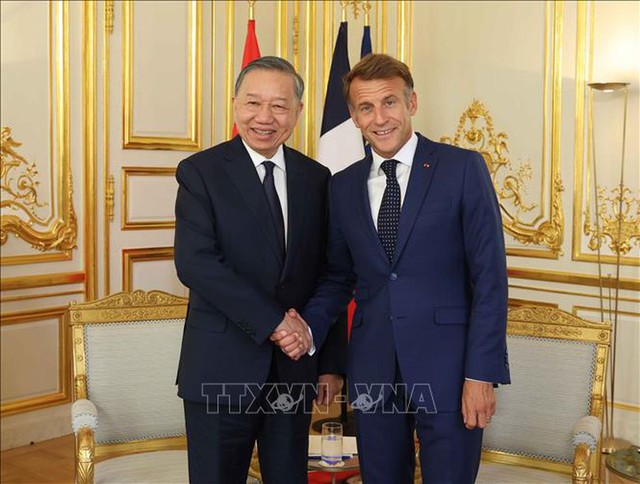
General Secretary and President To Lam (left) and French President Emmanuel Macron in Paris, September 10, 2026. Photo: VGP
The Australian expert noted that these efforts are closely linked to Viet Nam's domestic economic restructuring. Science and technology, innovation and digital transformation have been identified as motivations of higher productivity and new growth models. "During that process, international partnership relations are being leveraged to support Viet Nam's ambition to move up the global value chain, especially in semiconductors, energy, aerospace, digital systems and advanced manufacturing," Thayer noted.
Professor Nicholas Chapman from the University of Tohoku of Japan also agreed that technology diplomacy would provide strong support for Viet Nam's journey towards becoming a high-income country.
For Viet Nam, technology diplomacy includes a multidimensional approach to ensure resources for enhancing and expanding growing technological production capabilities. These resources include human resources, technology knowledge transfer and support to drive breakthroughs in clean energy and sustainable development, Chapman explained.
Thayer said that Viet Nam is pursuing a technology diplomacy policy tailored to different partners. Russia has strengths in nuclear energy, space, defense science, mathematics, engineering and advanced technologies. The two countries share a foundation of political trust and longstanding educational ties.
Meanwhile, France offers opportunities to access European research institutes, expertise in civilian nuclear energy, aerospace, railways, satellites, necessary mineral networks, and high-level technical education, Thayer added.
He went on to say that Viet Nam specifies different roles to different partners. This policy serves Viet Nam's objectives of diversification and strategic autonomy, specially in major-power competition and increasing fragmentation in global geopolitics context.
Expanding technology partnerships helps reduce excessive dependence on any single major power while creating greater room for manoeuvre, Thayer further explained.
Sharing this perspective, Professor Chapman emphasized that strategic autonomy in this context does not mean "acting alone." Rather, it means proactively expanding relations with major partners such as France and Russia to strengthen domestic capabilities and create a solid "buffer" against shocks such as supply chain disruptions, global energy crises and escalating trade tensions.
This strategy is both realistic and necessary, particularly as disruptions tend to have the greatest impact on smaller countries," Chapman commented./.