THE SOCIALIST REPUBLIC OF VIET NAM
Government News
Prime Minister Le Minh Hung calls on ASEAN, Japan to strengthen cooperation to ensure economic security
VGP - The 29th ASEAN-Japan Summit took place in Manila, the Philippines with the participation of ASEAN leaders and Japanese Prime Minister Takaichi Sanae.
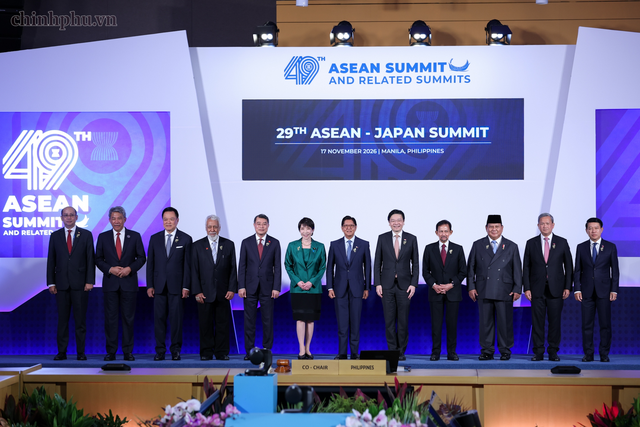
Leaders of ASEAN Member States and Japanese Prime Minister Takaichi Sanae attend the 29th ASEAN-Japan Summit in Manila, the Philippines, November 17, 2026. Photo: VGP
At the summit, the leaders highly valued the close friendship and substantive cooperation between ASEAN and Japan, built on a foundation of trust, equality, and mutual respect.
ASEAN leaders welcomed Japan’s active participation in and important contributions to regional cooperation mechanisms, as well as its support for ASEAN’s community-building efforts and the consolidation of ASEAN centrality.
Reviewing the state of cooperation, the leaders noted that ASEAN–Japan relations continue to achieve significant progress across all three pillars of their Comprehensive Strategic Partnership.
In terms of trade and economy, Japan is currently ASEAN’s fifth-largest trading partner and fifth-largest source of foreign direct investment (FDI). In 2025, the two-way trade reached US$245.4 billion, while total FDI from Japan into ASEAN stood at US$9.56 billion.
In science, technology, and innovation, the two sides have implemented numerous joint research projects, promoted cooperation in digital transformation and safe and trustworthy artificial intelligence (AI), and collaborated on human resource training and talent development.
Under the "Heart-to-Heart Partners" pillar, both sides have stepped up cooperation in education, cultural exchanges, sports, youth, and tourism. Under the "Partners for Peace and Stability" pillar, Japan has actively participated in regional security and defense dialogue and cooperation mechanisms, while strengthening collaboration with ASEAN on justice and addressing non-traditional security challenges, including maritime security, cybersecurity, and combating transnational crime.
Prime Minister Takaichi Sanae affirmed that Japan always attaches great importance to ASEAN’s unity and centrality, and pledged to work closely with ASEAN Member States to implement shared priorities—ranging from ensuring maritime security, combating transnational crime, and maintaining supply chains, to advancing science, technology, innovation, digital transformation, safe AI usage, disaster preparedness, and youth exchanges.
Looking foward to the 50th anniversary of the Fukuda Doctrine in 2027, Prime Minister Takaichi Sanae affirmed that Japan will remain a trusted partner, nurturing "heart-to-heart" ties and working alongside ASEAN to build a peaceful and prosperous future.
Regarding future directions, the leaders agreed to further strengthen the ASEAN–Japan Comprehensive Strategic Partnership, contributing effectively to regional peace, stability, security, and prosperity, while supporting the implementation of the ASEAN Community Vision 2045.
Both sides will strive to effectively implement the ASEAN–Japan Comprehensive Economic Partnership (AJCEP) and explore the possibility of upgrading the Agreement to incorporate new priorities. They also agreed to enhance cooperation to ensure economic security and resilience through joint initiatives in energy, food, supply chain resilience, disaster and climate change response, public health, and capacity building in science, technology, innovation, AI, and automation.
The two sides will coordinate the implementation of shared priorities in line with the ASEAN Outlook on the Indo-Pacific (AOIP) and Japan’s Free and Open Indo-Pacific (FOIP) 2.0.
Addressing the summit, Vietnamese Prime Minister Le Minh Hung noted that Japan has consistently been a trusted companion and a leading partner of ASEAN, sharing many common interests.
In the new context, the Prime Minister proposed that both sides continue to innovate and improve the effectiveness of their cooperation to co-create a future of development and prosperity.
In that spirit, Prime Minister Le proposed three priority orientations for the ASEAN–Japan Comprehensive Strategic Partnership in the coming time:
First, he proposed that both sides strengthen cooperation to ensure economic security, focusing on consolidating supply chains, securing supplies of critical minerals and semiconductors, and developing digital infrastructure.
He suggested ASEAN and Japan continue to expand cooperation in renewable energy and civil nuclear power, accelerating the implementation of the ASEAN Power Grid, and considering the upgrade of the AJCEP to incorporate new, relevant priorities.
In the field of public health, the Prime Minister called for continued close coordination to ensure the smooth and effective operation of the ASEAN Center for Public Health Emergencies and Emerging Diseases (ACPHEED).
Second, the Prime Minister proposed that ASEAN and Japan prioritize cooperation in institutional improvement, AI governance, digital workforce development, connecting startup ecosystems, and bridging the digital divide.
He welcomed both sides developing and implementing appropriate projects and activities within the frameworks of the ASEAN–Japan AI Co-Creation Initiative, the FOIP Digital Corridor, and the ASEAN Digital Economy Framework Agreement (DEFA).
Third, the Vietnamese Prime Minister proposed that ASEAN and Japan continue close coordination to contribute to maintaining peace, stability, security, safety, and freedom of navigation and overflight in the seas, including the East Sea, in accordance with international law, particularly the 1982 United Nations Convention on the Law of the Sea (UNCLOS 1982).
The summit concluded with the adoption of the Joint Statement on Realizing Economic Resilience, which sets out orientations and measures to enhance economic self-reliance and resilience, strengthen energy, food, and supply chain security, and bolster cooperation in digital transformation, AI, and innovation./.