THE SOCIALIST REPUBLIC OF VIET NAM
Government News
Prime Minister Le Minh Hung attends 29th ASEAN-China Summit
VGP - ASEAN–China relations have become one of ASEAN's most comprehensive, substantive, and important partnerships, noted Vietnamese Prime Minister Le Minh Hung while addressing the 29th ASEAN-China Summit in Manila, the Philippines, on November 16.
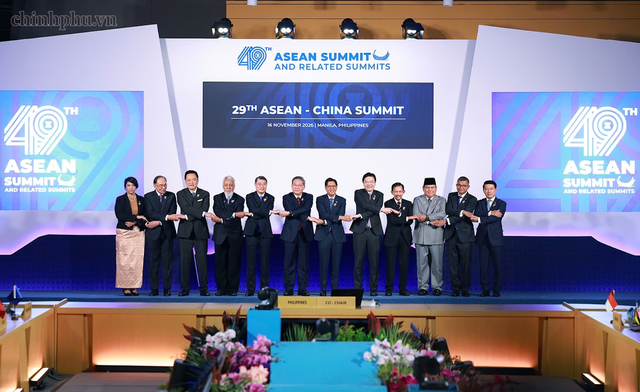
Leaders of ASEAN Member States and China attend the 29th ASEAN-China Summit in Manila, the Philippines, November 16, 2026. Photo: VGP
At the event, leaders of ASEAN Member States and China acknowledged and spoke highly of the comprehensive progress across all areas of ASEAN–China relations, which has brought tangible benefits to both sides.
For consecutive years, ASEAN and China have remained each other's top trading partners. In 2025, the two-way trade reached US$913.10 billion, while total foreign direct investment (FDI) from China into ASEAN stood at US$26.24 billion.
Within the framework of ASEAN-led mechanisms, political-security cooperation has continued to be strengthened. Cultural and people-to-people exchanges, as well as cooperation in sports and tourism, have flourished. ASEAN Member States welcomed 21.8 million Chinese tourists in 2025.
Regarding future directions, the leaders affirmed their resolve to further deepen the ASEAN–China Comprehensive Strategic Partnership, aligning with and complementing the ASEAN Community-building process, thereby contributing to consolidating peace, stability, and prosperity in the region.
Both sides agreed to double efforts in implementing the ASEAN–China Plan of Action for 2026–2030, placing high priority on enhancing economic and trade connectivity, with a particular focus on effectively realizing the ASEAN–China Free Trade Area (ACFTA) 3.0 Upgrade Protocol upon its entry into force in December 2026, thereby bolstering resilience and promoting inclusive growth.
The two sides will also expand exchanges and cooperation in science and technology, artificial intelligence (AI), digital transformation, energy and food security, infrastructure connectivity, agriculture, poverty eradication, and narrowing the development gap, while bolstering cooperation in education, health, culture, and people-to-people exchanges.
Comparing notes on international and regional issues, both sides underscored the imperative of maintaining peace and stability and agreed to step up coordination within ASEAN-led mechanisms and multilateral forums, upholding dialogue, cooperation, multilateralism, and international law.
Regarding the East Sea, the participating leaders shared the importance of maintaining peace, stability, security, safety, and freedom of navigation and overflight in the East Sea. They committed to promoting dialogue, building trust, peacefully resolving disputes, fully and effectively implementing the Declaration on the Conduct of Parties in the East Sea (DOC), and working toward the early conclusion of an effective and substantive Code of Conduct in the East Sea (COC) in accordance with international law, including the 1982 United Nations Convention on the Law of the Sea (1982 UNCLOS).
Chinese Premier Li Qiang emphasized that ASEAN and China share many common values and interests, and affirmed China's continued support for ASEAN centrality and the ASEAN Community Vision 2045.
Premier Li suggested that both sides should continue consolidating traditional friendship and mutual support, upholding multilateralism, free trade, and win-win cooperation, and seizing development trends driven by innovation and technological advancements.
Li also proposed that both sides continue joint efforts to maintain peace and stability, as well as dialogue to resolve differences, and promote common development and prosperity through economic integration, enhanced connectivity, and strengthened cooperation in science, technology, and AI, thereby delivering practical benefits to their peoples.
Addressing the summit, Vietnamese Prime Minister Le Minh Hung affirmed that ASEAN–China relations have become one of ASEAN's most comprehensive, substantive, and important partnerships.
To further elevate and deepen bilateral cooperation, Prime Minister Le suggested that ASEAN and China should actively expand exchanges and cooperation, strengthen joint responses to emerging non-traditional security challenges, and elevate cooperation and coordination at the United Nations and multilateral forums.
Le called on both sides to maintain positive momentum, strive for the early conclusion of an effective and substantive COC in accordance with international law, particularly the 1982 UNCLOS, while continuing the full and serious implementation of the DOC.
Le also proposed that both sides should prioritize the implementation of the ACFTA 3.0 Upgrade Protocol, accelerate the development of cross-border railways, smart border gates, and cross-border economic cooperation zones, connect the ASEAN Power Grid (APG), upgrade key economic corridors, and promote Mekong sub-regional development.
The Vietnamese Prime Minister called on both sides to connect innovation centers, research institutes, universities, and technology enterprises, while promoting joint research and high-quality human resource training.
On this occasion, Prime Minister Le welcomed the strengthening of ASEAN–China cooperation in the field of artificial intelligence.
At the conclusion of the Summit, the Leaders adopted the Joint Statement Commemorating the 5th Anniversary of the ASEAN–China Comprehensive Strategic Partnership, along with joint statements on strengthening bilateral cooperation in energy and forestry./.