THE SOCIALIST REPUBLIC OF VIET NAM
Government News
Policy speech by General Secretary and President To Lam at Copenhagen University
VGP - General Secretary and President To Lam delivered his policy speech titled "From Fairy Tales to the Horizon of Viet Nam–Denmark Cooperation in a New Era" at Copenhagen University on October 19 as part of his three-day State visit to Denmark.
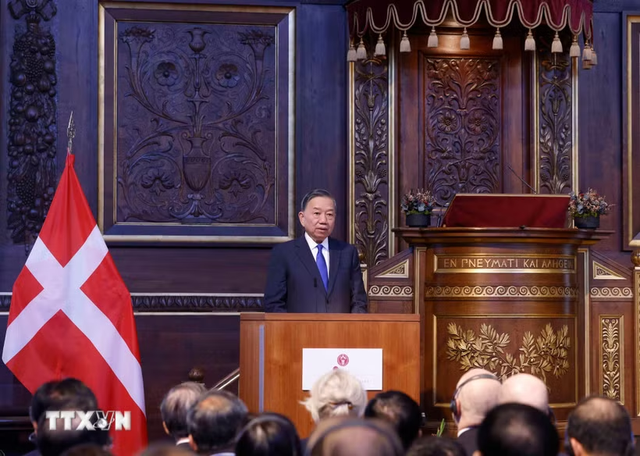
Dear Speaker of the Danish Parliament
Excellency Minister of Science, Higher Education and Digitalization,
Mr. Rector,
Distinguished Professors, Lecturers, Scientists, Students, and Dear Friends of Viet Nam,
It is a great pleasure for me to visit the University of Copenhagen, an institution with a history of nearly 550 years, as our two nations celebrate the 55th anniversary of the establishment of diplomatic relations. Here, among those dedicated to the pursuit of knowledge and the younger generation, I wish to share a vision for the future of relations between Viet Nam and Denmark.
To many Vietnamese, Denmark has long felt familiar through the fairy tales of Hans Christian Andersen. We came to know your country through The Steadfast Tin Soldier and The Little Match Girl with her humble dreams. These stories entered our childhoods, lodged in our memories, reminding each of us to cherish love, preserve hope, care for the less fortunate, and rise above adversity. Denmark's Little Match Girl resonates deeply with Viet Nam's Little Tam (Co Tam). A tiny pea can sprout into an entire world; a single match struck in the cold night can reveal a realm of warmth and hope. Danish fairy tales share remarkable parallels with Vietnamese legends such as The Story of the Star Apple Tree, The Hundred-Knot Bamboo, and Saint Giong.
The Danish people have a beautiful proverb: "The road to a friend's house is never long." The distance of nearly 9,000 kilometers between Ha Noi and Copenhagen has never posed a barrier, as our two peoples have consistently accorded each other mutual respect and sincere affection. Today's gathering with professors, students, and Danish friends carries a special significance—aimed at transforming this unique foundation of friendship into a new paradigm of cooperation in a new era.
Ladies and Gentlemen,
1. Viet Nam's Journey of National Rise
I wish to reflect briefly on Viet Nam's development story, as it opens up new horizons for bilateral relations.
Having endured a history of struggle for national independence and wars to secure peace, Viet Nam has steadfastly chosen the path of peace, independence, self-reliance, and cooperation for mutual development. We combine the consolidation of our internal strengths with the expansion of international cooperation, as no nation can stand alone in today's volatile world.
Following 81 years of nation-building and 40 years of Doi Moi (Renovation), Viet Nam has transformed itself from a war-torn, impoverished nation into a dynamic economy and a key link in global production chains.
With a GDP exceeding US$500 billion, Viet Nam ranks among the world's top 32 largest economies and leads the region in growth, while maintaining trade relations with over 230 economies, having signed 18 Free Trade Agreements (FTAs) involving more than 60 partners, and standing among the top 15 nations globally in trade volume.
From a blockaded and isolated country, Viet Nam now maintains diplomatic relations with 194 countries—including all UN member states—and has established Strategic Partnerships and Comprehensive Partnerships with 45 partners.
Viet Nam is entering a new era of development guided by two centennial goals: becoming a high-middle-income nation with modern industry by 2030, and a developed, high-income nation by 2045. This reflects our firm choice of an independent and self-reliant path—placing people at the center as the ultimate driving force, and utilizing knowledge and learning to narrow development gaps. Our nation is also preparing long-term visions for two subsequent centennial milestones in 2130 and 2145.
No longer relying on low-cost labor or natural resource exploitation, Viet Nam defines its development model as self-reliant, resilient, innovative, human-centric, sustainable, and globally integrated. In this pursuit, science, technology, innovation, and the knowledge economy serve as the core driving force; green transition and energy transformation offer opportunities to restructure the economy without sacrificing the environment; and education remains the top national priority.
The ultimate objective of economic growth is not measured in mere statistics, but in ensuring that citizens genuinely, equitably, and fairly enjoy its fruits, so that Viet Nam may become increasingly strong, prosperous and beautiful.
Viet Nam attaches profound importance to Denmark's lessons in social trust, transparent and accountable public administration, and policy stability. Recognizing numerous similarities and complementary strengths, Viet Nam regards Denmark as a trusted and important partner with whom to share experience, learn, and create new values for the journey ahead.
Ladies and Gentlemen,
2. A Friendship Nurtured Through Time
In 1971, amidst the height of war and devastation in Viet Nam, Denmark was among the very first European nations to establish diplomatic relations. That invaluable companionship during our most trying times stands as a testament to the adage: "A friend in need is a friend indeed." The people of Viet Nam remain deeply grateful for the sincere support of the Danish people during our struggle for national independence as well as in our country's reconstruction.
From these initial ties, bilateral relations have progressively expanded. Today, over 150 Danish enterprises operate in Viet Nam across pioneering, large-scale projects. After 55 years of diplomatic relations, bilateral cooperation has evolved from one-way assistance into a multi-dimensional, mutually beneficial partnership encompassing trade, investment, education, healthcare, and people-to-people exchanges, and now expanding further into energy, climate action, and technology.
From this 55-year journey of friendship, two major lessons emerge:
First, our relationship has been tested through historical ups and downs, forging a deep bedrock of strategic trust—a solid foundation for a new chapter of development.
Second, the substance of our cooperation must dynamically adapt to the demands of the era. Building upon the Comprehensive Partnership (2013) and the Green Strategic Partnership (2023), our two countries require a "new model of cooperation" that is more comprehensive and strategic—where Denmark's advanced capabilities in science, technology, and green transition meet Viet Nam's political resolve and rapid, sustainable development potential.
Ladies and Gentlemen,
3. Viet Nam–Denmark: Writing the Future Together
We are living in a volatile world marked by a reshaping international order, eroding strategic trust, challenges to international law, and rising unilateralism and protectionism. Yet, Viet Nam and Denmark share core commonalities: a spirit of self-reliance and resilience; respect for national sovereignty and territorial integrity; upholding international law and multilateralism; and keeping the doors to dialogue and cooperation wide open.
Regarding Denmark as a trusted friend and key partner, Viet Nam proposes five major orientations for future cooperation:
First, elevating cooperation from the Green Strategic Partnership to a more strategic and comprehensive framework.
This represents an imperative step toward making our bilateral cooperation an exemplary model between a Southeast Asian nation and a Nordic partner, enabling both countries to serve as strategic gateways and bridges in ASEAN and the EU, respectively.
Deep political trust, shared values, and similar visions will form the foundation to unlock expansive cooperative spaces: strengthening frequent exchanges across State, Parliamentary, political party, local, and business channels; broadening engagement into high-potential areas; and coordinating closely to address global issues.
Second, innovating approach to economic cooperation—shifting from assistance to co-creation and generating new value for both nations.
Viet Nam and Denmark not only complement each other in markets, resources, and technology, but also share common interests in building resilient supply chains and upholding free trade.
For Denmark, Viet Nam offers a destination for high-quality, long-term investments and serves as a strategic gateway for goods and services to access the 700-million-strong ASEAN market.
Under the EU–Viet Nam Free Trade Agreement (EVFTA), immense headroom exists to accelerate cooperation in areas where Denmark holds leading expertise: renewable energy and offshore wind power; maritime transport and green logistics; pharmaceuticals and medical technology; and sustainable agriculture.
Conversely, Vietnamese enterprises are establishing an increasing presence in Denmark in green transport, digital transformation, and artificial intelligence. Connecting infrastructure, logistics, and value chains between our two countries will form a vital link bridging Southeast Asia and the Nordic region. Given this vast potential, our target of US$1 billion in bilateral trade volume should be viewed as a starting point, not the ultimate destination.
Third, becoming priority partners in science, technology, green transition, just energy transition, and climate action.
Viet Nam pursues rapid growth but will absolutely not compromise its environment nor accept technological lag. Therefore, science and technology, green transition, and energy transformation must become landmark, breakthrough pillars of our bilateral relationship.
Scientific and technological cooperation should transition from ad-hoc exchanges to a structured mechanism under a bilateral cooperation framework to co-fund research, facilitate exchanges of young scientists, and enable selective technology transfer.
Right here at the University of Copenhagen, both sides can foster experimental sandboxes. Alongside technological domains, joint research should accord due emphasis to economics, social sciences, and policy research to address real-world challenges (such as the impact of green policies on employment, standards for small enterprises, or the efficiency of public resource utilization), thereby directly informing policy formulation and evaluation.
As a global pioneer in green transition and wind energy, Denmark possesses invaluable expertise in spatial planning and the marine economy.
Meanwhile, Viet Nam boasts over 3,200 km of coastline with offshore wind potential among the highest in the region.
This synergy will not only forge a new industry and an exemplary model of renewable energy cooperation contributing to global climate efforts, but also lay the groundwork for Denmark to partner with ASEAN in grid planning for the ASEAN Power Grid.
Fourth, placing human connectivity, education and training, and people-to-people exchanges at the durable core of bilateral relations.
To achieve sustainable development, a nation must cultivate new capacities. Viet Nam faces a pressing demand for high-quality human resources, while Denmark possesses an outstanding scientific and educational foundation—exemplified by the University of Copenhagen. The positive outcomes achieved in healthcare and non-communicable disease management should be replicated across other frontier fields, including biotechnology, pharmaceuticals, digital technology, and artificial intelligence.
To attract and empower talent, Viet Nam is striving to build a research environment that honors quality, integrity, and impactful contributions, while expanding international cooperation for young scientists.
Our two countries should develop joint research teams, co-supervise doctoral candidates, and share research infrastructure to cultivate a long-term generation of intellectuals. Notably, Viet Nam invites the University of Copenhagen to consider opening a branch campus in Viet Nam, pledging the most favorable conditions regarding taxation and land access to serve students from Viet Nam and across Southeast Asia.
Bilateral ties are truly enduring only when nourished by mutual understanding and popular affection. Direct flight routes alongside educational exchanges, scholarships, and cultural programs are continually bridging the geographical distance. Our partnership is vividly present—from Andersen's fairy tales and Lego toys that nurture childhoods, to Pandora and Carlsberg products in every home; from wind turbines illuminating households, to the melodies of Michael Learns to Rock echoing across Vietnamese stages.
Finally, the Vietnamese community in Denmark—particularly experts, scientists, entrepreneurs, and students—serves as a vital bridge in driving cooperation opportunities and connecting the younger generations of both nations.
Fifth, joining hands for peace, cooperation, and development, and jointly addressing regional and global challenges.
In today's world, no nation can single-handedly address global challenges such as climate change, food security, water security, or shifts in the international order.
As active and responsible members of the international community, Viet Nam and Denmark share a belief in multilateralism, international law, and the peaceful resolution of disputes through dialogue.
Here at the University of Copenhagen, I am reminded of Niels Bohr—a legendary scientist who bound great discoveries with a profound responsibility for peace. In his Open Letter to the United Nations in 1950, he called for an open world where cooperation and mutual understanding prevent the perils created by technological progress itself.
That message underscores shared responsibility for peace—a spirit that is ever more compelling as humanity navigates the advances of artificial intelligence and emerging technologies. Nations must enhance dialogue regarding responsibility, safety, and community well-being, and Viet Nam looks forward to working alongside Denmark to make tangible contributions to these efforts.
Furthermore, our two countries should maintain close coordination at the United Nations and multilateral forums, while promoting substantive progress in ASEAN–Denmark and ASEAN–EU relations.
As maritime nations, Viet Nam hopes Denmark will support ongoing efforts to ensure maritime security, safety, and freedom of navigation in accordance with international law, particularly the 1982 United Nations Convention on the Law of the Sea (UNCLOS). In sharing these core values, Viet Nam–Denmark relations will transcend a bilateral framework to contribute positively to a peaceful, equitable, and sustainably prosperous world.
Ladies and Gentlemen,
4. Reflecting on the past 55 years—from our shared companionship during arduous times—Viet Nam and Denmark have built deep mutual trust to open up a new horizon of cooperation.
The Danish have a saying: "When many shoulders share the load, the burden becomes light." We in Viet Nam likewise say: "A single tree cannot make a hill, but three trees together form a majestic mountain."
In the face of global volatility and challenges, it is precisely our unity of mind, shared knowledge, and side-by-side companionship that will enable our two nations to turn every challenge into an opportunity. On this journey, the students sitting here today are the vanguard force destined to write even brighter future chapters.
To recall the symbolism of Andersen's pea story: if the past 55 years represented a journey of the first generations sowing the seeds, today is the moment for us to plant new ones. The future story between Viet Nam and Denmark will be written not only through the magic of fairy tales, but through trust, knowledge, resolve, and the shared determination of both our peoples.
May the friendship and cooperation between Viet Nam and Denmark continue to flourish across generations, making positive contributions to peace, prosperity, and a better future.
Thank you very much./.
________
For reference only