THE SOCIALIST REPUBLIC OF VIET NAM
Government News
Korean President Lee’s visit marks a step toward more substantive Viet Nam–South Korea relations
VGP - The upcoming state visit to Viet Nam by Korean President Lee Jae Myung and his spouse from April 21–24 is expected to advance the implementation of high-level agreements and generate more substantive outcomes in bilateral cooperation, said Kwon Sung Taek, President of the Korea–Viet Nam Economic and Cultural Association (KOVECA).
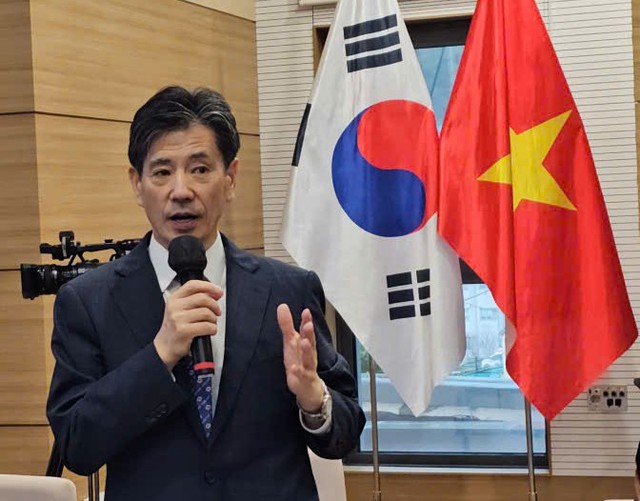
President of the Korea–Viet Nam Economic and Cultural Association (KOVECA) Kwon Sung Taek
Kwon made the above statement ahead of the state visit by Korean President Lee Jae Myung and his spouse to Viet Nam at the invitation of General Secretary and President To Lam.
The visit is expected to review the implementation of agreements reached during the two leaders' meeting in Seoul last August and translate commitments into concrete economic outcomes, particularly in future-oriented sectors.
The trip follows General Secretary To Lam's official visit to South Korea in August 2025—the first by a Vietnamese head of state in 11 years—which laid a solid foundation for deepening bilateral ties.
Key discussions during the visit are expected to focus on energy security, including nuclear power, high-speed rail, urban development, large-scale infrastructure, supply chain resilience, and high-tech cooperation. Both sides are also likely to outline measures to achieve the bilateral trade target of US$150 billion by 2030, signaling a shift toward a more innovation-driven partnership.
Kwon noted that both leaders share a pragmatic approach, prioritizing public welfare, national interests, and regional peace. This alignment is expected to reinforce the Comprehensive Strategic Partnership and pave the way for expanded cooperation across politics, diplomacy, defense-security, culture, and people-to-people exchanges.
Regarding cultural cooperation, the relationship is evolving beyond economic engagement toward the formation of a "cultural community." The two countries aim to strengthen collaboration in culture, sports, tourism, and people-to-people exchanges, including joint artistic activities and cooperation in the entertainment industry. The Korean Wave (Hallyu) continues to maintain a strong presence in Viet Nam and is increasingly embedded in daily life.
Cooperation in this field is also shifting from content consumption to co-production, combining Korean creative expertise with Viet Nam's production capabilities. Kwon suggested developing K-pop training models in Viet Nam to nurture V-pop artists while leveraging Vietnamese cultural elements and Korean storytelling techniques to reach global markets.
Economically, while major conglomerates such as Samsung, LG, Hyosung, and Hyundai Motor have driven bilateral ties over the past three decades, the next phase is expected to see broader participation from small and medium-sized enterprises (SMEs). This shift is anticipated to support more balanced and sustainable growth in economic relations.
SME cooperation could expand into technology transfer, joint ventures, and digital transformation, helping Korean firms localize supply chains while enabling Vietnamese companies to enhance competitiveness. Joint research and development initiatives may also foster the emergence of globally competitive startups.
Kwon highlighted Viet Nam's rapidly growing e-commerce market as an opportunity for Korean SME brands, particularly in cosmetics and food. He called for supportive government measures, including the development of business-to-business platforms, expansion of joint funds, streamlined certification procedures, and enhanced tax incentives. The involvement of Korean IT firms in supporting digital transformation among Vietnamese SMEs was identified as an effective model.
In terms of human capital, Viet Nam currently ranks first in the number of international students in South Korea, many of whom are pursuing science and technology fields.
The KOVECA President stressed the need to move beyond labor cooperation toward a comprehensive strategy for jointly developing high-quality human resources.
He proposed establishing a joint education ecosystem linking universities and enterprises, including a potential "South Korea–Viet Nam High Technology University," and leveraging Korean firms' R&D centers in Viet Nam to facilitate knowledge exchange.
"Such initiatives would promote a "brain circulation" model, contributing to sustainable talent development and retention in both countries," he finalized./.