THE SOCIALIST REPUBLIC OF VIET NAM
Government News
General Secretary To Lam receives European Council President António Costa
VGP - General Secretary To Lam hosted a reception for President of the European Council António Costa in Ha Noi on January 29.
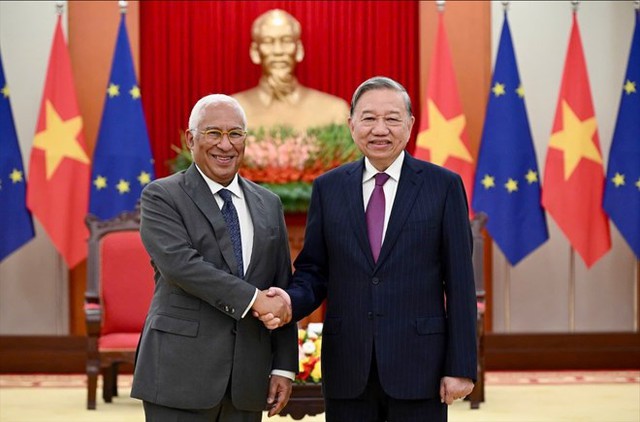
General Secretary To Lam (R) and President of the European Council António Costa, Ha Noi, January 29, 2025 - Photo: VGP/Nhat Bac
President Costa's official visit to Viet Nam came shortly after the successful conclusion of the 14th National Congress of the Communist Party of Viet Nam and coincided with the upgrade of Viet Nam–EU relations to a Comprehensive Strategic Partnership. The timing underscored the depth of bilateral ties and the shared strategic vision as the Viet Nam-EU relationship enters a new phase of development.
At the meeting, General Secretary To Lam briefed his guest on the key outcomes of the 14th National Party Congress, noting that the Congress set long-term goals for national construction and development not only for the 14th tenure but also beyond.
He highlighted VietNam's two centennial goals: becoming a developing country with modern industry and upper-middle income status by 2030, and a developed, high-income nation by 2045, with annual growth targeted at 10 percent or higher during the 2026–2030 period.
The Party chief stressed that Viet Nam would continue to renew its development mindset, focus on in-depth growth, build an independent and self-reliant economy alongside deep and extensive international integration, ensure social welfare, and improve the quality of education and health care.
He reaffirmed that safeguarding independence, sovereignty and stability remains the foundation for national development, emphasizing that foreign affairs are a key and regular task, pursued through a consistent policy of independence, self-reliance, resilience, diversification and multilateralization, equal and mutually beneficial cooperation, and respect for international law and the United Nations Charter.
On Viet Nam–EU relations, General Secretary To Lam affirmed that Viet Nam attaches great importance to the EU and to its partnership with the bloc, noting that Viet Nam is the first ASEAN country to establish a Comprehensive Strategic Partnership with the EU—the highest framework for bilateral cooperation.
He described the upgrade as a historic milestone, reflecting strong political trust and high determination on both sides. In the context of intertwined challenges and opportunities, he stressed the need for increased exchanges and dialogue to further strengthen political trust and translate the new partnership framework into concrete and effective cooperation.
For his part, President Costa said he was pleased to visit Viet Nam shortly after the 14th National Party Congress and, on behalf of the EU, congratulated General Secretary To Lam on his re-election. He noted that Viet Nam's achievements have enhanced its international standing and generated positive impacts across the region.
With bilateral ties elevated, President Costa said the EU seeks to deepen cooperation with Viet Nam in areas such as free trade, supply chain diversification, green transition, marine economy, transport infrastructure, security and defense, freedom of navigation, and the joint response to global challenges, for peace and cooperation at both regional and global levels.
Agreeing with the Vietnamese leader's proposals, Costa affirmed that the EU will work closely with Viet Nam to develop and implement a substantive and effective roadmap for the EU–Viet Nam Comprehensive Strategic Partnership. Key priorities include strengthening high-level exchanges, enhancing coordination at multilateral forums, effectively implementing the EU–VietNam Free Trade Agreement (EVFTA), and promoting cooperation in security and defense, science and technology, and innovation, particularly in training high-quality human resources in technology-related fields.
Regarding regional and international issues, the two leaders agreed to continue close coordination to uphold international law, multilateralism and the peaceful settlement of disputes in line with the UN Charter, while advancing shared international agendas to address non-traditional security challenges./.