THE SOCIALIST REPUBLIC OF VIET NAM
Government News
General Secretary, President To Lam delivers keynote address at Shangri-la Dialogue 2026
VGP - General Secretary and President of Viet Nam To Lam delivered a keynote address at the 23rd edition of the Shangri-la Dialogue - Asia's premier defense summit, in Singapore on May 29.
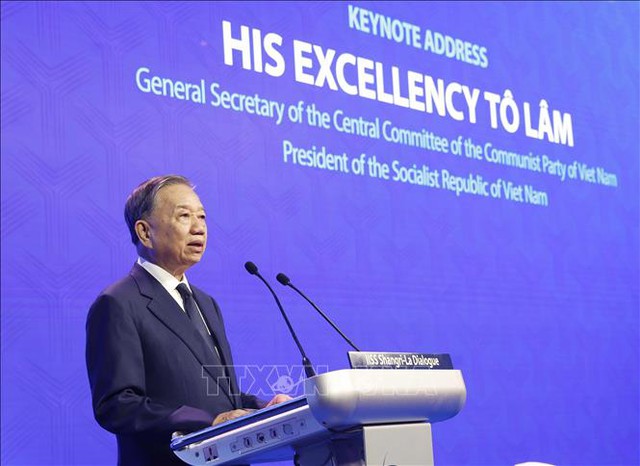
General Secretary and President of Viet Nam To Lam delivers a keynote address at the Shangri-la Dialogue in Singapore, May 29, 2026. Photo: VNA
The Dialogue brings together defence ministers, military leaders and senior defence officials, as well as business leaders and security experts, from across the Asia-Pacific, Europe, North America and beyond to discuss critical security challenges.
In his address, the top Vietnamese leader shared his perspectives on how Asia-Pacific can work together to ensure peace, stability, development, and resilience while minimizing risks early and from afar.
As the word is concurrently facing three crises: global order crisis, development model crisis, and strategic trust crisis, the Vietnamese leader suggested six major orientations for Asia-Pacific.
First, rules and dialogue must be transformed into effective instruments for tangible risk reduction. The Shangri-La Dialogue is a platform where nations listen to one another, clarify intentions, seek common ground, and manage differences; however, dialogue should not stop at the mere statement of positions. Dialogue must help identify risks early, share information, maintain communication channels during tensions, and prevent differences from sliding into crises. Furthermore, a rules-based order does not belong to any single group of nations; rather, it is the common foundation for large, medium, and small countries to coexist peacefully. This must be based on international law and the UN Charter, respecting independence, sovereignty, territorial integrity, abstaining from the use or threat of force, and resolving disputes through peaceful means and sovereign equality. Rules only retain their vitality when they are consistently enforced and translated into concrete mechanisms, such as early warning systems, emergency hotlines, incident management protocols, self-restraint, and verifiable cooperation.
This is particularly crucial for seas and oceans. Seas and oceans are resources, shared spaces for connectivity, and the lifelines of global trade, energy, food, and supply chains. No nation benefits if these connecting routes become arenas for power demonstration, coercion, or confrontation.
Regarding the East Sea, Viet Nam's position is consistent, clear and principled. Viet Nam supports the resolution of all disputes and differences through peaceful means, on the basis of international law, particularly the 1982 United Nations Convention on the Law of the Sea (UNCLOS). Viet Nam respects the legitimate and lawful rights and interests of other nations, while resolutely and persistently defending its own independence, sovereignty, sovereign rights, and jurisdiction in accordance with international law.
Second, it is essential to construct an open, inclusive, and ASEAN-centric regional architecture. In the context of numerous emerging mechanisms and initiatives, we need to build an architecture capable of aligning interests, reducing suspicion, and complementing existing frameworks. Every initiative that contributes to peace, stability, and development should be welcomed, provided it is transparent, respects international law, remains mutually complementary, and does not undermine ASEAN centrality or turn Southeast Asia into an arena for confrontation. ASEAN centrality is neither inherently given nor self-sustaining. ASEAN can only maintain this role through unity, strategic autonomy, and the capacity to shape a shared agenda. Inclusivity must be coupled with effectiveness, dialogue must translate into action, and consensus must enable the region to respond in a timely manner to common challenges. Viet Nam supports and stands ready to cooperate closely with the Philippines in its capacity as the ASEAN Chair 2026, alongside other member states, to consolidate peace and security, expand corridors of prosperity, and promote connectivity as well as inclusive and sustainable development with ASEAN citizens at the center.
Third, human security and social resilience must be placed at the heart of sustainable security. Today's instability stems not only from military conflicts but also from disruptions in development. Therefore, while strengthening national defense is a legitimate need, sustainable security cannot rely solely on military might, or arms race or by causing insecurities to other nations. What we need is a development foundation highly resilient to shocks, open and diversified supply chains, seamless infrastructure connectivity, and cooperation in finance, technology, and human resources. Concurrently, we must foster practical cooperation in disaster relief, public health, water, food, and energy security, cybersecurity, critical infrastructure protection, and search and rescue operations. Once cooperation guarantees safety, secures livelihoods, and improves the living standards of the people, strategic trust will be consolidated and nurtured.
Fourth, it is necessary to establish standards of responsibility for emerging technologies and the defense industry. Artificial intelligence, big data, quantum technology, autonomous systems, space technology, cybersecurity, and high-tech supply chains are reshaping international security. While these technologies can expand development capabilities, risk forecasting, and governance, they can also be weaponized for cyberattacks, information manipulation, conflict automation, illicit surveillance, or new forms of coercion. In defense and security, the critical question is not how powerful a technology is, but to what extent humans can maintain control over it. Therefore, we must promote dialogue on AI in defense and security, ensure ultimate human accountability in decisions with severe consequences, establish codes of conduct in cyberspace, protect undersea cables and critical data infrastructure, and ensure transparency regarding technologies that impact strategic stability. The defense industry must serve legitimate self-defense and regional stability, rather than becoming a driver for arms races.
Fifth, it is essential to reinforce social foundations and resilience, protect the information space, and raise public awareness. In a deeply digitally connected world, instability stems not only from military conflicts, supply chain disruptions, or cyberattacks, but can also originate from the erosion of social trust. Fake news, information manipulation, incitement to extremism, social polarization, and targeted influence campaigns can undermine national consensus, distort public perception, deepen divisions, and accelerate the spread of crises. Therefore, safeguarding peace in the new era also requires protecting the truth, reinforcing social trust, enhancing strategic communication capabilities, educating digital citizens, promoting the accountability of tech platforms, and fostering international cooperation to combat disinformation. A society capable of discerning right from wrong, maintaining consensus amidst volatility, and refusing to be driven by fear, hatred, or manipulation will serve as a vital foundation for sustainable security.
Sixth, it is essential to enhance capabilities in preventive diplomacy, mediation, and arbitration within the region. Many crises erupt not solely due to conflicting interests, but because the parties lack reliable channels of communication, space for de-escalation, and mechanisms to steer confrontation back toward dialogue. Therefore, the Asia-Pacific must treat preventive diplomacy as a strategic capability rather than a reactive measure after a crisis has already unfolded. We need more diverse consultation channels, flexible mediation mechanisms, contact groups for incidents, semi-official forums, and confidence-building initiatives among militaries, security and law enforcement agencies, academia, businesses, and social organizations. The objective is to create "diplomatic off-ramps" before parties are drawn into an escalatory spiral that risks conflict.
To our highly influential partners both within and outside the region, Viet Nam wishes to convey a sincere message: the Asia-Pacific is an open space, where every nation with legitimate interests can contribute to peace, stability, and development. The region welcomes an engagement that is transparent, responsible, respectful of international law, supportive of ASEAN centrality, and conducive to easing tensions. What the region desires is not the mere presence or absence of any major power, but a responsible commitment. We view competition as inevitable, but competition must be bound by the limits of law, transparency, and self-restraint.
The three crises facing today's world are not an inevitability that we must blindly accept. What matters is that we confront these crises head-on, without allowing them to obscure our opportunities for action. The crisis of the international order demonstrates that international law and self-restraint must be reinforced. The crisis of development models shows the need to renew growth drivers toward inclusivity, sustainability, and a human-centric approach. The crisis of strategic trust demands dialogue, transparency, responsibility, and more substantive cooperation mechanisms.
These answers will not emerge on their own. They can only become a reality if nations collectively maintain and shape rules, connect interests, foster trust, and build risk-mitigation mechanisms that are genuinely effective in practice. In a volatile world, challenges stem not only from external uncertainties but also from our own lack of adequate preparation in risk management. The key lies in shifting from passive response to proactive shaping; from merely reiterating principles to operationalizing mechanisms; and from managing crises after they occur to mitigating risks before they erupt.
Therefore, the choice for the Asia-Pacific today is not between competing or not competing, as competition is an inherent reality of international relations. The more critical choice is between unconstrained competition and responsible coexistence; between division and dialogue; between suspicion and coercion versus an order rooted in rules and trust. Viet Nam believes that our region possesses the resilience and shared interests required to choose the path of peace, cooperation, and prosperity.
Through the lens of our own history, Viet Nam profoundly understands the value of peace; through our own journey of Doi Moi (Renovation) and integration, we deeply appreciate the value of development. From this experience, Viet Nam is acutely aware that our national interests are inextricably linked with the peace, stability, and prosperity of the region. Contributing to regional peace is, fundamentally, safeguarding Viet Nam's own long-term interests. Expanding cooperation, mitigating risks, and aligning legitimate interests are precisely how Viet Nam fulfills its responsibility toward the international community.
Peace, stability, and development constitute the common denominator for all nations and peoples. However, these ideals only bear true meaning when translated into concrete actions: exercising self-restraint amidst disagreements, engaging in dialogue as differences widen, cooperating when challenges transcend borders, and building risk-mitigation mechanisms that are genuinely operational in practice.
In this spirit, Viet Nam stands ready to work alongside nations within and outside the region to reinforce rules, cultivate trust, promote dialogue, enhance cooperation, mitigate risks, and collectively shape a safer, more resilient, and more prosperous Asia-Pacific.
On the sidelines of the Shangri-la Dialogue, Genera Secretary and President To Lam hosted receptions for U.S. Secretary of War Pete Hegseth, Australian Deputy Prime Minister and Defense Minister Richard Marles, and Japanese Defense Minister Koizumi Shinjiro.
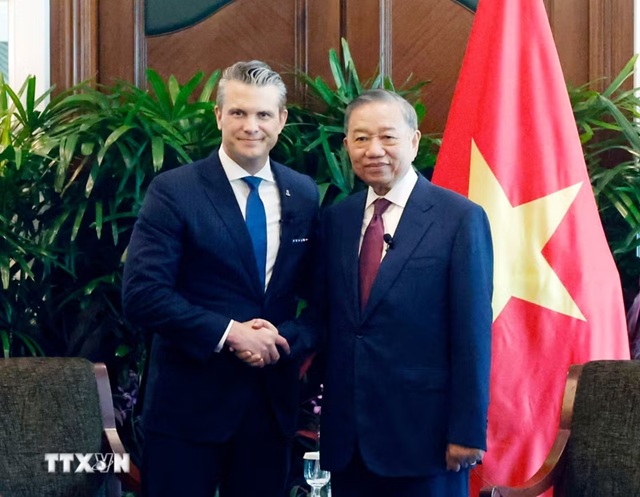
General Secretary and President To Lam meets U.S. Secretary of War Pete Hegseth in Singapore, May 29, 2026. Photo: VNA
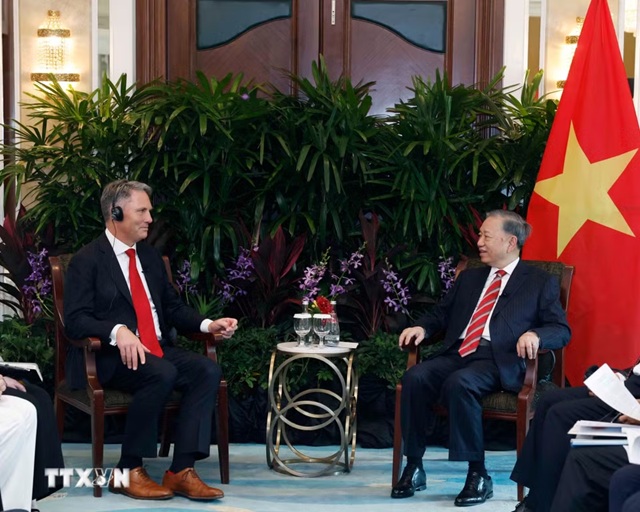
General Secretary and President To Lam meets Australian Deputy Prime Minister and Defense Minister Richard Marles in Singapore, May 29, 2026. Photo: VGP
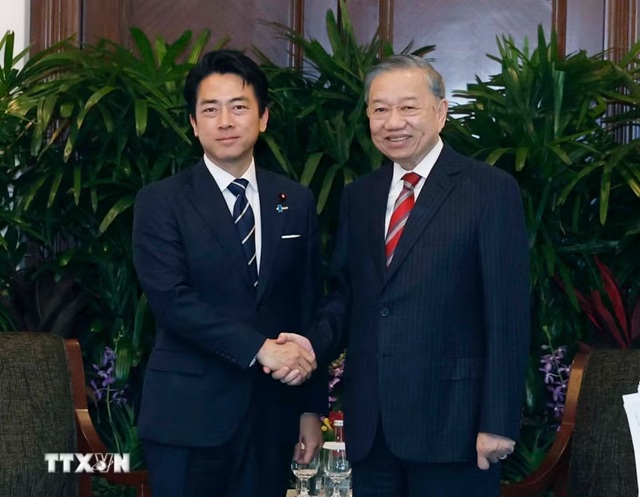
General Secretary and President To Lam meets Japanese Defense Minister Shinjiro Koizumi in Singapore, May 29, 2026. Photo: VNA