THE SOCIALIST REPUBLIC OF VIET NAM
Government News
General Secretary, President To Lam begins three-day State visit to Thailand
VGP - General Secretary and President To Lam on Wednesday starts a three-day State visit to Thailand at the invitation of Thai Prime Minister Anutin Charnvirakul.
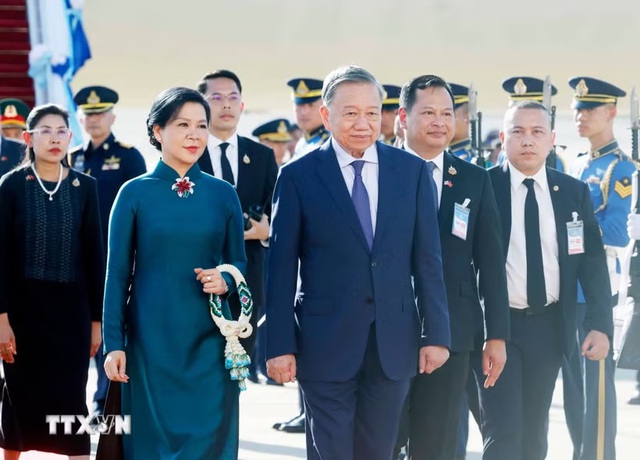
General Secretary and President To Lam and his Spouse Ngo Phuong Ly arrive in Bangkok this afternoon for a three-day State visit to Thailand
To Lam is accompanied by Chairman of the Central Organization Commission Nguyen Duy Ngoc; Chairman of the Central Communication, Education and Mass Mobilization Commission Trinh Van Quyet; Chairman of the Central Policy and Strategy Commission Nguyen Thanh Nghi; Deputy Prime Minister and Minister of National Defense Phan Van Giang; Minister of Public Security Luong Tam Quang; Minister of Foreign Affairs Le Hoai Trung; Secretary of the Ha Noi Municipal Party Committee Tran Duc Thang; Chairman of the Office of the Communist Party of Viet Nam Central Committee Nguyen Hai Ninh; Vice Chairwoman of the National Assembly Nguyen Thi Hong; Chairman of the Presidential Office Le Khanh Hai; Minister of Finance Ngo Van Tuan; Minister of Science and Technology Vu Hai Quan; Minister of Industry and Trade Le Manh Hung; Assistant to the General Secretary and President To An Xo; and Vietnamese Ambassador to Thailand Pham Viet Hung.
Speaking to Vietnamese reporters ahead of the visit, Thai Ambassador to Viet Nam Urawadee Sriphiromaya said the visit carries great significance for the bilateral relations.
She highlighted that Thailand was chosen as the first ASEAN destination for the Vietnamese leader's regional tour, underscoring the importance of bilateral ties. Thai authorities, as well as Thai citizens of Vietnamese origin, are looking forward to welcoming the high-level Vietnamese delegation.
The diplomat stressed that Thailand and Viet Nam are now Comprehensive Strategic Partners, the highest level of cooperation between Viet Nam and foreign countries.
Both sides are expected to discuss in detail the implementation of the Comprehensive Strategic Partnership, particularly through a new Plan of Action for the 2026–2031 period. The plan will cover cooperation across multiple sectors and aims to deliver concrete outcomes that support peace, security, and prosperity for both countries.
The visit takes place amid a rapidly changing and challenging international environment. In this context, consultations between leaders are important for coordinating responses to regional and global challenges, including maintaining peace and stability in Southeast Asia, promoting the ASEAN agenda, and strengthening cooperation on energy security, food security, and combating transnational crimes such as cybercrime, she unveiled./.