
THE SOCIALIST REPUBLIC OF VIET NAM
Government News
Expanding markets for fruit and vegetable exports
VGP - In the 2011-2015 period, fruits and vegetables proved to be one of Viet Nam’s stable export items, registering a high annual growth rate of 26.5% and earning the country US$2 billion in 2015 alone.
 |
|
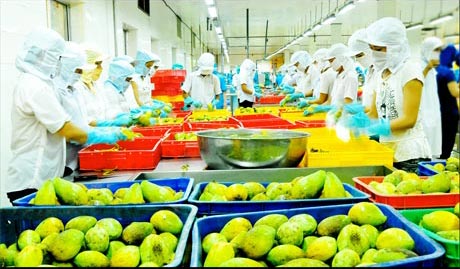
Illustration photo |
The country’s fruits and vegetables have now been exported to more than 60 countries and territories.
Besides traditional markets like China, Japan and the Republic of Korea, Vietnamese fruit and vegetable products now penetrate new markets such as Hong Kong, the UAE and Holland and strict markets like New Zealand and the US.
In recent years, Viet Nam’s fruits and vegetables have marked their presence in many demanding markets with strict requirements on plant quarantine, and food safety and hygiene barriers.
As revealed by the agricultural sector, many other demanding markets will continue to open their doors to Viet Nam’s fruits and vegetables this year. Specifically, the Animal and Plant Health Inspection Service (APHIS) under the US Department of Agriculture (USDA) has finalised a report analysing probabilistic risk assessment (PRA) of Viet Nam’s mango and star apple, in a move to open doors for these two fruits to enter the US market in 2016.
In addition, the agricultural sector is also accelerating negotiations aiming to bring its six key fresh fruits - dragon fruit, rambutan, longan, lychee, mango and pomelo - to Japan, Thailand, the Republic of Korea and Argentina.
These positive signals light up hopes that 2016 will see the strong development of advanced technology in the field of fruit and vegetable production, creating favourable conditions for new breakthroughs of this significant export item.
With these measures combined smoothly and implemented synchronously, Viet Nam’s fruits and vegetables will be able to build on the success achieved over the past years and can definitely look towards greater success in 2016.
Successful exports to strict markets show that Vietnamese fruits and vegetables are moving to meet international standards.
However, the export of fruits and vegetables remains largely dependent on Asia with seven out of 10 largest importers of Vietnamese fruit and vegetables being Asian markets, including China, the Republic of Korea, Japan, Taiwan, Thailand, Singapore and Malaysia
Throughout the country, there are more than 100 processing plants of fruit and vegetable with a combined capacity of 300,000 tones per year. The Viet Nam Fruit and Vegetables Association said that companies should invest in advanced technologies to process fruit and vegetable products. The link between plantation areas and processing plants are also critical to ensure quality.
In the coming time, many kinds of fruit such as mango, dragon fruit, mangosteen and grape and flowers like rose and carnation will be shipped abroad./.
By Vien Nhu