
THE SOCIALIST REPUBLIC OF VIET NAM
Government News
European businesses remain upbeat about Viet Nam’s economic outlook
VGP - European investors' business confidence in Viet Nam stood at 78.3 points in the third quarter of 2026, according to the EuroCham Business Confidence Index (BCI) report released on Thursday.
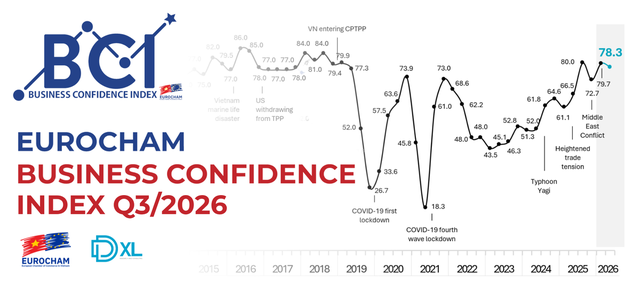
The above figure fell slightly by 1.4 points from the previous quarter but remaining at a historically high level, reflecting sustained investor confidence despite global economic uncertainties.
Viet Nam's GDP expanded by 9.95 percent year-on-year in the third quarter and 9.01 percent in the first nine months of 2026. However, EuroCham Chairman Bruno Jaspaert noted that headline growth figures alone do not fully reflect conditions on the ground, where local supply chains, manufacturing facilities and distributors continue to face rising costs and regulatory pressures.
He stressed the need to translate national economic growth into more predictable and efficient business conditions.
The Chairman also stressed that the key task now is to make growth more tangible across the economy by improving predictability, strengthening resilience and consolidating reforms, enabling businesses to devote more of their energy to creating value.
The survey also revealed contrasting trends across sectors and business sizes. Confidence in the agriculture and food value chain rose 11.7 points to 83.9, while the tourism and hospitality sector's index fell 22.5 points to 67.9, amid changing consumer spending patterns, higher operating costs and extreme weather.
Business sentiment also varied by company size. While 97 percent of enterprises employing more than 500 people said they would recommend Viet Nam as an investment destination, between 14 and 17 percent of small businesses with 1–50 employees expressed caution.
Despite persistent operational challenges, 90 percent of respondents said they would recommend Viet Nam to investors. The country's key advantages included human capital, cited by 52 percent of respondents, cost competitiveness at 51 percent, and political and macroeconomic stability at 44 percent.
Viet Nam's appeal to foreign investors lies in its competitive costs, skilled workforce, political and macroeconomic stability, domestic market, extensive free trade agreements and strategic location. Registered FDI reached US$50.36 billion in the first nine months of 2026, while disbursed capital hit a five-year high of US$21.07 billion. Both large enterprises and SMEs contribute to economic growth through investment, innovation, technology and job creation.
Resolution No. 10/NQ-TW on the development of the foreign-invested economic sector, dated June 8, 2026, aims to improve investment quality by promoting technology transfer, innovation and domestic supply chains, shifting the focus from capital attraction to broader economic value and capabilities./.